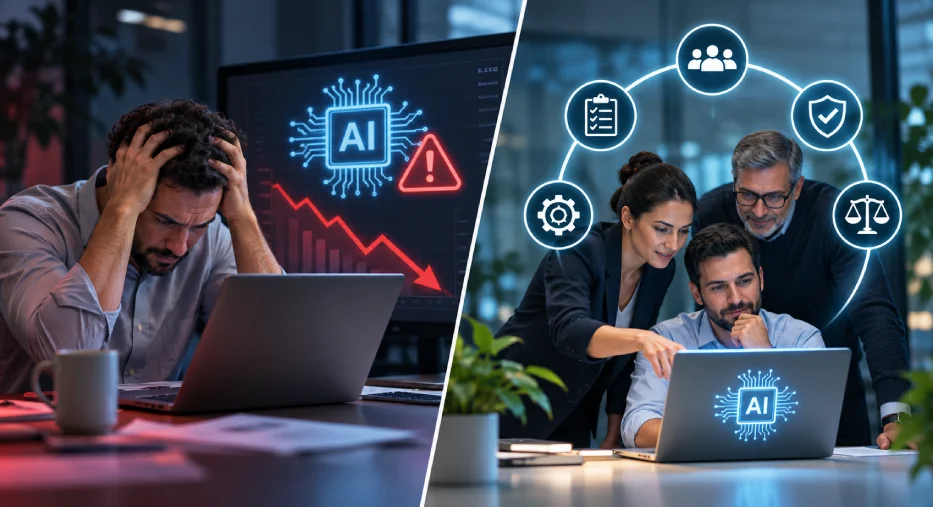
Many company leaders faced big losses with software tools this year. They spent millions of dollars on new smart computer tools. Yet these projects failed to show real money results. Company boards want to know why AI projects fail in 2026 and where the money went. The real answer is very simple. Computer tools do not fix broken work steps. Smart software needs people to check the work. Without people in charge, these smart systems make costly mistakes. Management usually purchases technology before considering human resources. This results in great disparity in the way things are done. Errors tend to propagate throughout the system very quickly without any form of oversight of the output. A proper framework should exist for this to be solved.
The Big Gap in Smart Technology Governance
The issue of smart systems being inefficient results from the lack of attention to human factors. This is referred to as AI governance gap analysis. Organizations invest huge sums of money into software but then overlook its basic check and balancing aspects. Consequently, mistakes occur on a daily basis. When the software comes up with an answer without any verification by humans, the risks increase significantly. The software may present its conclusions with utmost confidence while they are completely wrong. Without human control, such mistakes affect your customers directly, which leads to loss of trust.
Comparison of Workflows
| Work Area | Fully Automated System | System With Human Oversight Framework AI |
|---|---|---|
| Output Quality | High error rates and bad decisions | Double checked accuracy and high standards |
| Customer Experience | Cold responses and robotic mistakes | Warm personal tone with verified facts |
| Team Support | Workers feel scared and bypass tools | Staff feel empowered and work faster |
| Safety and Legal | High risk of data leaks and policy breaks | Full compliance with human safety checks |
| Cost Control | High costs fixing automated mistakes | Steady savings with high task speed |
You must treat smart software like a new worker who needs help. You would not leave a new team member alone without a boss. You must treat smart computer tools the same way.
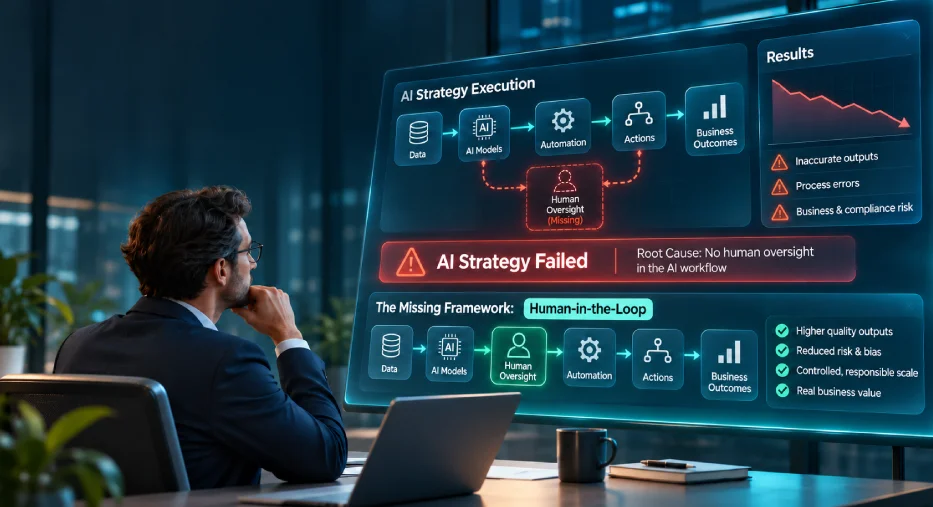
Root Causes Behind Smart Software Failures
We studied many project failures to find out what went wrong. Every single project had similar problems. Here is the AI deployment root cause breakdown from real company cases.
- No Clear Strategic Goals: Companies buy tools because of hype rather than real operational needs.
- Skipping Human Validation: Rushing production without setting up an AI output validation workflow.
- Staff Fear and Resistance: Employees fear job loss, leading to change management resistance to AI issues.
- Poor Input Data Quality: Feeding unverified data into systems leads to synthetic data bias correction needs.
- Missing Error Tracking: Failing to maintain an automated decision audit trail over time.
Organizations tend to be too hasty to implement new tools without preparing their personnel for them. Employees become fearful that the tools will replace their jobs. Thus, they do not apply them or ignore the negative outcomes. It causes an obvious human-in-the-loop problem within all organizational units. The other big problem is poor-quality data. When you input poor-quality records into a tool, you receive poor-quality results. Intelligent systems cannot correct poor-quality background records by themselves. They only allow making wrong decisions much faster than a human can.
"Smart computer tools do not replace human thought. They only multiply what your team is already doing. If your process is messy, smart software just creates faster chaos." - Tech Industry Research Group, 2026
Step-By-Step AI Project Recovery Plan
If your software project is struggling right now, do not panic. You can fix it using a clear step-by-step method. This AI project recovery plan helps you regain control and save your tech budget.
[Stop Bad Work] ---> [Check Data Quality] ---> [Add Human Checks] ---> [Train Workers] ---> [Track Results]
Action Steps for Immediate Recovery
- Cease Uncontrolled Operation: Stop right away all automated systems that deliver results to clients directly without being checked.
- Perform Data Lineage Testing: Know where your data is coming from and clean it up before sending it to software.
- Set Out Handover Criteria Between AI & Humans: Clearly outline how the transition from machine to person will be made.
- Educate People on Limitations of Tools: Train your people to detect problems with models or software.
- Introduce Continuous Monitoring Guidelines: Review the output weekly for precision and reliability.
Once you start to involve your team in the process again, you have increased speed and decreased mistakes. Your people make difficult decisions, and your computer makes easy, repetitive decisions.
Why Human-in-the-Loop Systems Matter
The only way to safeguard your business is through a human-centered oversight structure built by AI. Humans provide a level of context, empathy, and moral security that computers simply cannot offer. Core Benefits of Human Oversight
- Contextual Accuracy: Humans understand nuances, humor, and cultural context that software misses.
- Ethical Safety: Real people catch harmful biases or offensive outputs before public release.
- Adaptability: Humans adjust quickly to unexpected real-world changes that throw off computer models.
- Accountability: A clear AI accountability framework ensures people take responsibility for final outcomes.
Although computers perform numerical computations quickly, they lack an understanding of the reality around them. This means that the software can discover patterns which would make no sense in reality. Humans will prevent this bad pattern from causing any damage.
Detailed AI Strategy Failure Reasons in 2026
Why do so many systems fall short this year? Look closely at the main AI strategy failure reasons holding enterprise teams back today.
- Leadership Disconnect: Executives order technology adoption without understanding daily operational workflows.
- Weak Oversight Rules: Teams lack clear human oversight best practices 2026 guidelines for daily tasks.
- Ignoring Small Drift: Failing to notice algorithmic drift detection alerts early when output quality dips.
- Inadequate Training: Spending budget on software license keys while spending nothing on employee skill building.
- Data Security Oversight: Ignoring regulatory compliance checkpoint steps when feeding internal data into tools.
"True digital transformation fails when software is treated as a replacement for human intellect rather than an amplifier of team expertise." - Global Technology Governance Report, 2026
Without these fundamentals, your project will fail to succeed. You can’t undo poor planning with a better and more advanced tool. Your project requires good management and people who will monitor the daily outputs.
Algorithmic Drift Detection and Fixes
Technology changes over time. As soon as there are changes in real-time data, the accuracy of technology goes down quickly. The name for this phenomenon is algorithmic drift detection.
Performance Degradation Metrics
| Time Period | Model Accuracy | Error Frequency | Action Required |
|---|---|---|---|
| Month 1 | 98% | Very Low (1 in 100) | Initial baseline established |
| Month 3 | 89% | Low (1 in 10) | Minor model tuning needed |
| Month 6 | 72% | Moderate (3 in 10) | Re-train system with new data |
| Month 12 | 45% | Severe (1 in 2) | Full system pause & reset |
However, if your tools are not tested on a monthly basis, their responses become increasingly poor. An accurate decision from last year could now be the wrong one. It is the reason why human-AI handover procedures are essential for every company. Your employees will have to intervene when confidence levels fall.
Setting Up an AI Output Validation Workflow
For any piece of content and decision generated from any tool, you need to have a defined process of validating AI-generated output.
Key Components of Validation
- Confidence Score Thresholds: Tasks scoring below 95% certainty must go straight to a human reviewer.
- Sampling Checks: Randomly sample 10% of automated outputs every day for manual audit.
- User Feedback Integration Loop: Collect customer complaints to find where software makes quiet errors.
- Exception Handling Protocols: Create clear steps for how staff should handle system crashes or bizarre outputs.
To begin, put together some simple criteria for how the software is allowed to work alone. Simple actions such as sorting e-mails in the inbox can happen quickly. Complex actions such as authorizing customer loans or crafting legal language always require human eyes. Secondly, include an automated decision audit trail in your software program. Each decision made by the software needs to be logged into. This will help your team understand the reason behind the decision by the software.

Stopping Stakeholder Trust Erosion
Bad judgment from intelligent tools leads to a quick loss of confidence in the leadership among the stakeholders, which affects the team’s morale.
Bad Software Output ---> Customer Complaint ---> Team Frustration ---> Loss of Trust
Employees begin to question all outputs of the system. Managers refrain from utilizing the reports generated automatically. In no time, people revert to old methods, and you have wasted all your budget on technology.
Trust Restoration Steps
- Constitute a cross-functional AI review committee including representatives of legal, technology, and operations functions.
- Prepare and share monthly accuracy and error reports to ensure full transparency.
- Encourage employees to identify software errors before customers experience any trouble.
- Provide an easy guide for troubleshooting AI strategy in case of software errors.
Enterprise AI Risk Assessment Essentials
Before starting any tool project, do an enterprise AI risk assessment to find hidden dangers.
| Risk Category | Key Vulnerabilities | Mitigation Strategy |
|---|---|---|
| Model Performance Degradation | System drift over time | Regular retraining cycles & audits |
| Ethical AI Escalation Matrix | Unintentional bias in choices | Human review panel for sensitive cases |
| Change Management Resistance AI | Employee fear and low tool usage | Hands-on workshop training & incentives |
| Synthetic Data Bias Correction | Skewed training datasets | Thorough manual checks of data sources |
| Shadow AI Detection | Unapproved third-party tools | Clear corporate policies & safe tools |
Addressing these risks early protects your project from sudden failure down the road.
Financial Control and Real ROI Measurement
A lot of leaders end up making the mistake of calculating wrong ROI on AI by looking only at cost of tools without considering time taken to review manually, cost of training and setup cost. You can only save money by adding tool speed with human skill, not by replacing your most talented people.
Total Tool Cost = Software Subscription + Staff Training Time + Human Review Hours
"Calculating ROI without factoring in human verification hours is the single biggest accounting mistake in modern tech budgeting." - Corporate Finance Review, 2026
ROI Calculation Breakdown
- Software Costs: License fees, API usage charges, server hosting.
- Human Costs: Hours spent reviewing outputs, training time, management oversight.
- Risk Costs: Fixing errors, handling customer refunds, and legal compliance checks.
Finding Operational Bottlenecks and Shadow Tools
Smart tools can cause an operational bottleneck identification problem when human reviews take too long. If your team gets flooded with tool outputs, they cannot check them fast enough.
[Tool Creates 1,000 Reports] ---> [Only 2 Humans to Review] ---> [Massive Bottleneck!]
- Cognitive Load Assessment: Measure if staff feel overwhelmed; review hundreds of automated alerts daily.
- Streamlined Review Queues: Group similar outputs so reviewers can check them in efficient batches.
- Clear Priority Flags: Use smart filters to send urgent or high-risk items to top-tier experts first.
The next concealed threat can be that of shadow AI detection within your organization. The employees use these free tools on the Internet without informing the IT department. The employees upload secure company data through public websites, making the secure data available to the public Internet. You require a good compliance checkpoint to prevent the use of such dangerous tools. Provide the employees with safe tools so that they don’t seek other unsafe options themselves.
Protecting Your Business from Vendor Lock-In Risks
It is important to understand that relying on just one technology vendor makes you extremely vulnerable to vendor lock-ins. If this vendor decides to change the price or the terms, there will be nothing you can do.
Vendor Risk Management Checklist
- Keep raw records safe in your own files through proper data lineage verification.
- Avoid proprietary data formats that cannot be exported to other systems.
- Use modular system designs so you can swap out core tools without rebuilding everything.
- Build custom exception handling protocols, so operations continue if a vendor goes down.
Create internal controls that will ensure the sustainability of your business regardless of any change in terms of the external IT services.
Step-by-Step Oversight Checklist for 2026
Use this actionable AI audit template to keep your team on track every week.
Weekly Oversight Tasks
- Inspect decision log files for strange patterns or incorrect decisions.
- Compare the accuracy of software responses with human answers once a month.
- Update user feedback loops with comments from customer support groups.
- Calculate the measure of team cognitive load assessment to ensure that employees are not overworked with software reviews.
- Inspect continuous monitoring compliance to ensure data protection and hygiene.
- Governance matrices download with department managers review.
- AI strategy alignment expert session with leadership.
Following this step-by-step oversight checklist keeps your smart systems safe, accurate, and truly useful.
Real-World AI Failure Case Study
One of the major retailers used automatic software for setting product prices in late 2025. There was no human intervention at all. Due to changes in market prices, the prices of thousands of products were reduced automatically by the system.
[Market Price Shift] ---> [Tool Lowers Prices Automatically] ---> [$2 million Loss in 48 Hours]
Key Takeaways from the Case Study
- The system ran without an ethical AI escalation matrix to alert managers of extreme price drops.
- No human-in-the-loop validation was required for price cuts over 15%.
- The mistake cost over two million dollars in just 48 hours.
- The company recovered only after implementing a strict CrecenTech AI framework for oversight.
Rebuilding Strategy with CrecenTech
In cases where technological initiatives fail, you should have proper guidelines to solve the issue. In this case, you should not require software that is much more complicated. Rather, what you need are improved methodologies and proper human oversight mechanisms.
To rebuild your software strategy the right way, partner with CrecenTech Systems for reliable, human-centered tech solutions.
Emphasis should be laid on creating efficient teams that utilize technology as an assistant. This is how successful firms will scale their operations in 2027 and beyond.