
That said, it is easy to expect instant results. Automation tools promise speed and scale, but real value comes with time. The best results often grow out of small experiments: watching how people interact with your content, adjusting your workflows, and learning what works (and what does not) along the way.
Let’s be real for a second, getting leads (aka people interested in your product or service) isn’t that hard anymore. With some money, catchy ads, and a half-decent deal, people will probably click on the button. However, here is the challenge: getting those people to stick around, trust you, and make a purchase.
That is where marketing automation comes in.
Not as some magic robot that does everything for you, but as an innovative tool that keeps things moving even when your marketing team is asleep or busy doing something else.
But hold up, before we hype it up too much, let us be honest. Marketing automation isn’t a perfect “set it and forget it” tool. It can be clunky or annoying if done wrong. But when used with care, it can change the game.
So, What Is Marketing Automation, really?
On paper, it is simple: marketing automation refers to a set of tools that help marketers streamline, automate, and measure workflows across various channels, including email, web, CRM, social media, and more.
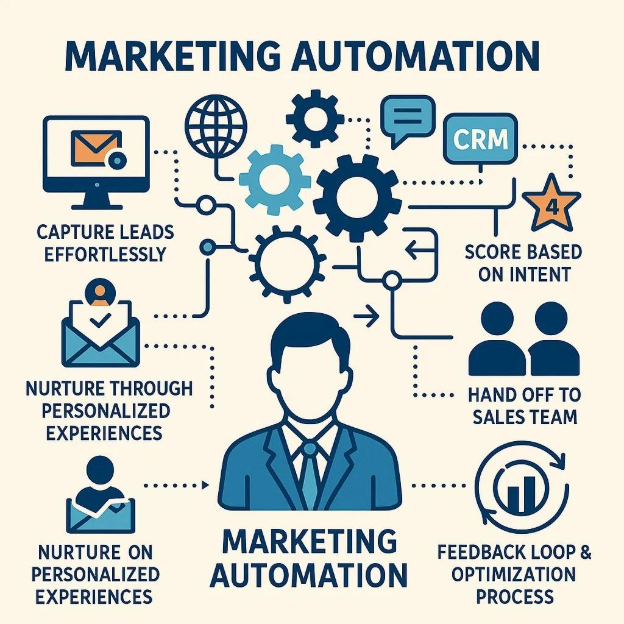
It replaces repetitive tasks with workflows that are always on, always learning, and continually improving. With the right automation tools, you can:
- Capture leads effortlessly
- Nurture them through personalized experiences
- Score them based on intent
- Hand off the prospects to your sales team.
- Create Feedback Loop & Optimization Process
It is not just about “automating tasks.” It is about building a system that teaches someone to respond to user behavior in real-time, escalating or easing off depending on signals that might otherwise go unnoticed.
Capturing Leads & Sustaining Them
Marketing automation helps in capturing leads. Although many marketers assume that marketing automation only begins after someone fills out a form, such as when they download an e-book or sign up for a demo, this is not necessarily the case.
Realistically, some of the most powerful automation begins much earlier before the visitor even enters their contact information. Through dynamic landing pages, adaptive forms, and behavioral tracking, automation tools begin collecting fragments of intent. And it is in those fragments, clicks, and scrolls that you can start shaping a better response.
HubSpot, Marketo, and Pardot are commonly used tools to track how someone interacts with your site in real-time. This could be through dynamic landing pages, smart forms, and behavioral tracking. These platforms begin collecting signals, including clicks, scroll depth, time spent on the page, repeat visits, and other relevant data.
Each of these interactions helps build a profile, often tied to an anonymous cookie. As the visitor returns or engages with more content, the system connects these behaviors. It starts adapting the experience, offering more relevant CTAs, showing personalized messaging, or adjusting form fields based on what is already known.
Of course, not everyone agrees on how much tracking is too much. There is an ethical layer here, one that is becoming harder to ignore. Should every movement on a website translate into a profile, tag, or campaign? Some argue that hyper-personalization verges on manipulation. Others claim it is just a good user experience (UX).
Still, what seems clear is this: relevance matters. And automation, when used thoughtfully, can help brands respond to leads in ways that feel less like cold outreach and more like meaningful dialogue.
Lead Segmentation Using Insights into Behavioral Tracking
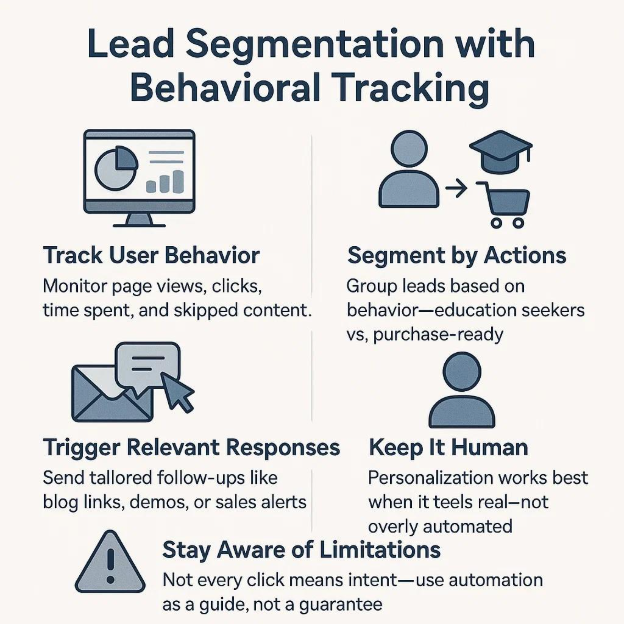
One of the most valuable benefits of automation is lead segmentation. It extends far beyond simply tagging leads by job title or company size. Today’s systems can group people based on their behavior, such as how often they visit your site, what content they are drawn to, or what they skip entirely.
For example, a lead who reads a how-to blog post might get a follow-up email offering more educational content. Meanwhile, someone who spent 20 minutes exploring your pricing page might trigger a sales alert or get added to a more direct nurture campaign.
These automated workflows are designed to treat different people differently, because they are not all looking for the same thing.
And while this might sound robotic, the outcome is surprisingly personal. When a message lands at just the right moment and speaks to what the lead cares about, it does not feel like automation. It feels like someone gets you.
Still, it is not a perfect science.
Just because someone clicks around your site does not always mean they are ready to make a purchase. They could be curious, doing research for a teammate, or just passing the time. So, while automation is excellent at spotting patterns and sorting people into buckets, it is not mind-reading.
Ultimately, effective segmentation enables you to communicate more efficiently with leads. Still, it is always worth remembering that human intent can be complex, and not every click necessarily means a commitment. The best automation tools recognize that, too, and leave room for honest conversations when the time is right.
Drip Campaigns and Email Workflows for Lead Nurturing
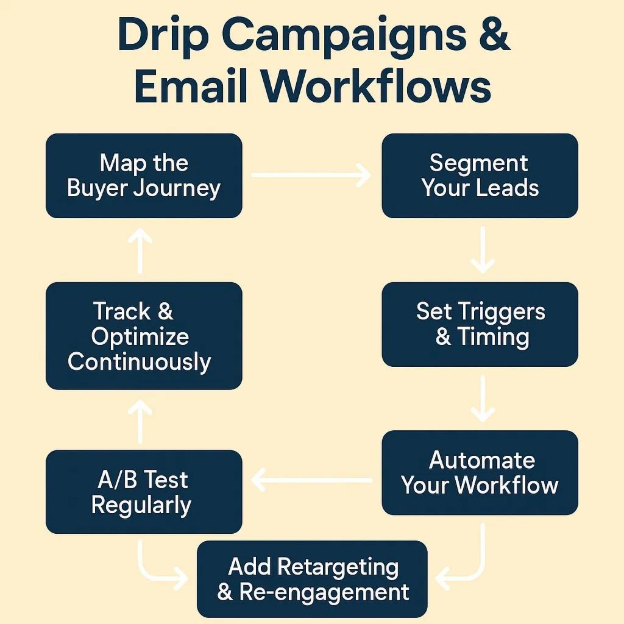
One of the most powerful features of marketing automation is the ability to create drip campaigns, an automated series of emails sent based on user behavior or timing. These campaigns nurture leads until they are ready for sales.
In many businesses, especially those in the SaaS sector, lead nurturing is often viewed as a necessary step before closing a deal. As if once, someone enters your pipeline, there is a straight path to the sale.
But genuine buyers do not move in straight lines. They browse your site, disappear for months, and then return when something shifts, maybe their budget, team, or priorities. This unpredictability is precisely why marketing automation is crucial.
With tools like triggered emails, retargeting ads, and re-engagement campaigns, you can stay visible without constantly chasing leads. When done well, you provide helpful content at just the right time. When done poorly, you become the brand that floods their inboxes with five “Just checking in” emails in two weeks.
Here is something most people will not say aloud: a lot of nurturing content is not great. It is forgettable, generic, or too pushy. Automation cannot magically fix weak content—but it gives you a system to test what works, improve what does not, and keep trying new things without starting over each time.
So, in the end, nurturing is not about following a strict playbook. It is about being ready when the lead appears in a way that adds value.
Lead Scoring and Smart Prioritization
If you ask five marketers how their score leads, you will probably hear five different answers. Some give points for actions like opening emails or filling out forms. Others believe it is too basic and that those actions do not always mean genuine interest.
They are both right, to an extent.
Lead scoring can be helpful when you receive many leads, and your sales team cannot reach everyone. But it only works well if the system behind it makes sense.
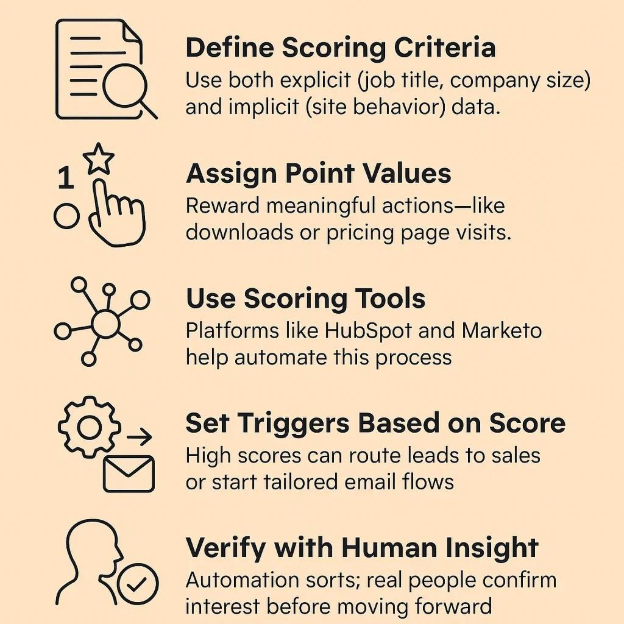
Many B2B SaaS and professional services teams now use hybrid models. These combine two kinds of data:
- Explicit data – like job title, company size, or industry
- Implicit data – like how often someone visits your site, how long they stay, or which pages they view
Tools like HubSpot, Salesforce Pardot, or Marketo enable you to build these scoring models using logic rules. For example, someone who downloads a whitepaper might earn 10 points. If they come back the next day and check the pricing page? That could trigger another action, like directing them to sales or initiating a custom email series.
But here is the catch: no matter how detailed your scoring is, it is not perfect.
A lead might seem “hot” based on points but still have no interest in making a purchase. That is why many teams let automation handle the first step, sorting and scoring leads, but leave the final verification to a human representative, who can confirm if the interest is genuine.
Because in the end, the best scores do not close deals. People do.
Functional Alignment of Sales and Marketing Teams
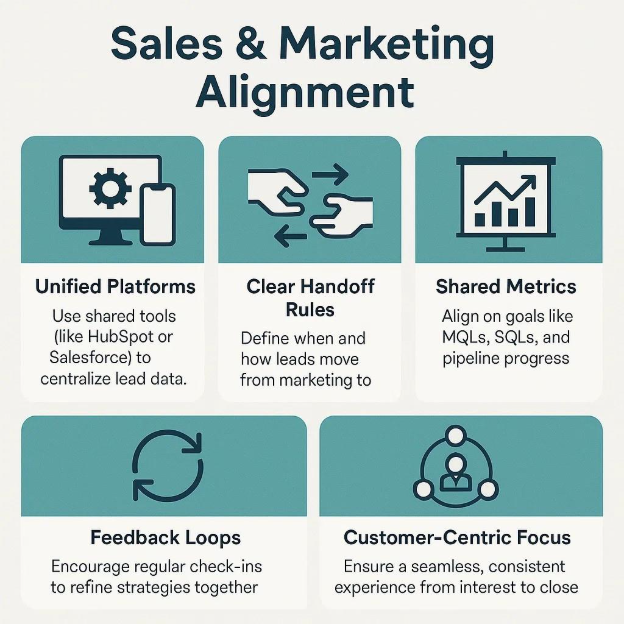
One of the biggest strengths of marketing automation is its ability to connect two teams that often feel like they are on different planets: sales and marketing.
When both teams work within the same automation platform, whether it is HubSpot, Salesforce, or another platform, things start to fall into place. Leads do not get lost between systems.
Salespeople know which contacts are worth following up with. And marketing gets honest feedback about what is working and what is not.
For the customer, this ideally means a smoother experience. They receive helpful content when they are still exploring, and personalized outreach when they are ready to engage. No awkward gaps. No repeated questions.
Still, having automation in place does not guarantee everything will run smoothly. Tools are only as good as the people using them. Real alignment requires effort, including regular meetings, shared goals (such as SQLs or MQLs), and a willingness to tweak campaigns when the data indicates that something isn’t working, even if the software suggests it should.
Ultimately, automation should support strategy. Not replace it.
Choosing the Right Automation Platform
There’s no shortage of tools vying for your attention and your budget. You have probably seen the charts, comparison grids, and “top 10 marketing automation platforms of the year” lists.
However, most of them are messy, and the contextual reality of how these tools function in the real world may differ.
It could be argued that the real question is not what is the best platform, but what is the best fit for your team, right now, given your constraints and goals?
Let us break that down a bit.
1. Business Size and Internal Capacity
Smaller businesses such as startups, solo founders, and lean marketing teams often gravitate toward platforms like HubSpot, Mailchimp, or ActiveCampaign. And understandably so. These tools tend to prioritize usability over raw power. You can launch campaigns quickly, without needing a full-time admin or an in-house developer.
But as organizations grow, the needs shift. You start craving deeper segmentation, more sophisticated lead routing, and better reporting. That is where Salesforce Marketing Cloud, Marketo, or Pardot start to feel justifiable, if not essential.
Yet there is a catch: these platforms are not plug-and-play. They are ecosystems. And if you are not ready to invest in overhead-technical onboarding, process documentation, internal training, they can just as easily become burdens as benefits.
2. Budget, But Not Just Budget
Price tags matter, obviously. However, what often gets overlooked is the cost of adoption, not just the subscription fee, but also the time, support, and personnel required to run it effectively.
For instance, you might find that Marketo technically offers everything you need; however, unless someone on your team is fluent in its logic and workflows, that potential will remain untapped. Meanwhile, a more modest tool like MailerLite or Brevo might outperform simply because it is being used.
So yes, it is worth comparing pricing tiers. But it is even more important to ask: Can my team realistically take advantage of this? Or will it just sit there, half-configured and collecting dust?
3. Integration is Often the Deal-Breaker
A sleek UI or clever feature set can be tempting, but if your platform cannot integrate with your CRM, CMS, or analytics stack, you will hit walls quickly. Some tools offer native integration. Others rely on third-party connectors. And a few unfortunately require custom code just to synchronize contact data properly.
Integration hiccups are more than technical nuisances. They can slow down campaigns, break reporting, and frustrate both marketing and sales. When choosing a platform, prioritize compatibility with your current tech ecosystem over flashy extras.
There is a certain irony here: the more “all-in-one” a platform claims to be, the more it tends to struggle with playing nicely with others.
4. Skills Over Features
Lastly, and perhaps most critically: Do not let a list of features seduce you. It is often the case that the most powerful tools are also underutilized. Choose something that aligns not just with where you want to go, but with what your team can handle today.
You do not need a jet engine if you are still learning how to taxi.

Advanced Automation Tactics
Now that we know how to set up your lead magnets, welcome emails, and basic workflows, it is easy to sit back and let things run. But that is usually when your automation starts to feel “good enough,” even if it is not working as well as it could.
Let us level up; here are a few advanced strategies that can take your setup from just okay to truly effective.
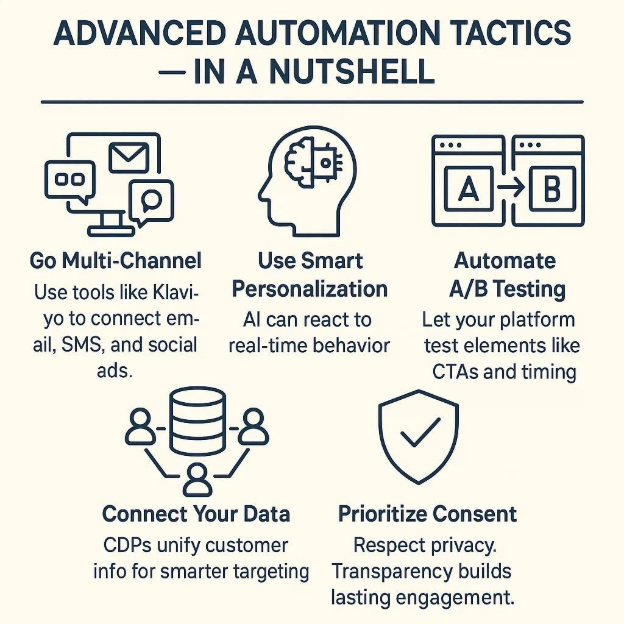
1. Multi-Channel Automation: Beyond the Inbox
While email has long been automation home turf, modern buyers toggle between inboxes, social feeds, mobile alerts, and ad networks often within the same hour. So, it only makes sense that your automation efforts should not live in a silo.
Tools like Klaviyo, ActiveCampaign, or Salesforce Marketing Cloud allow for cross-channel
orchestration: A user downloads a guide → they receive a follow-up email → fail to open it, and they’re shown a remarketing ad on Instagram → engage again, and an SMS reminder nudges them toward a demo.
Is this complex to set up? Absolutely. Is it worth it? Often, though not always. The key is relevance. If every channel echoes the same message, the experience feels robotic. But when each touchpoint builds on the last, the effect can be surprisingly human.
2. AI-Powered Personalization: More Than Just “Hi, FirstName”
There is growing excitement, along with some warranted skepticism, surrounding AI in automation. Tools now claim they can predict behaviors, adjust content, and segment audiences with remarkable precision. Some of that is true. Some of it, frankly, is marketing hype.
That said, it is becoming increasingly possible to respond to real-time signals, such as a return visit to a pricing page, an abandoned cart, or a flurry of email opens. AI can take these signals and automatically trigger different copy, cadence, or offers—at least in theory.
But, again, a caveat: automation does not mean intelligent solutions. If you feed your system poor logic or incomplete data, all the AI in the world will not save you from sending awkward, irrelevant messages.
3. Automated A/B Testing: Let the Platform Decide
Rather than choosing one subject line and crossing your fingers, automated testing lets your platform run the experiments and surface the winner for you.
You might test:
- Subject line length
- CTA button placement
- Timing of follow-up messages
- Visual layout vs. plain-text email
It is an efficient way to optimize but only if you let results inform strategy. One-off tests mean little if you do not act on what you learn.
4. CDP Integrations: From Fragmented Data to Unified Action
Most teams struggle with fragmented data, with one set stored in the CRM, another at the helpdesk, and yet another in the product backend. A Customer Data Platform (CDP) aims to solve this by pulling all customer data, behavioral, transactional, and demographic, into a central hub.
From there, automation can get much smarter. Imagine targeting users who have reached a usage
threshold, contacted support twice, and have not logged in for 10 days. All within a single sequence.
It is powerful. But the learning curve is real, and not every team is ready to implement it cleanly. So be cautious here. Sometimes, “good enough” segmentation is preferable to overengineered complexity.
5. Privacy and Compliance: The Quiet Differentiator
Finally, we cannot ignore the reality of privacy. GDPR, CCPA, and other data regulations are reshaping how automation works and how it is perceived.
Building consent-based workflows is more than risk mitigation; it is a signal of trust. Let users control what they receive. Track opt-ins transparently. And do not treat unsubscribed users as failures; their boundaries are not rejections.
Paradoxically, the more you respect a user’s autonomy, the more likely they are to stay engaged.
Final Worlds
If there is a takeaway here, it is that marketing automation is not inherently good or bad. It is a tool set. And like any toolset, it reflects the intention behind it.
When it is rushed or overdone, automation can feel cold and impersonal. Maybe even annoying. But when it is used with intention, tested, tweaked, and built around real human behavior, it can make your lead generation feel smarter, more personal, and more useful.
That said, it is easy to expect instant results. Automation tools promise speed and scale, but real value comes with time. The best results often grow out of small experiments: watching how people interact with your content, adjusting your workflows, and learning what works (and what does not) along the way.
So, if you are getting started, keep it simple. Be curious. And aim for the kind of automation that does not feel automated at all, just natural, helpful, and right on time.