
Not everything that is scalable should be. Automation, for all its convenience, tends to flatten nuance. It delivers messages, yes, but does it provide meaning? Possibly. Though some might argue that lead nurturing isn’t about moving people along a funnel, but about not being forgotten while they figure things out. And that requires something automation rarely provides patience without pressure. Relevance without noise. A kind of quiet consistency. The truth is that most tools can be followed up with. Fewer can truly connect. And when trust is the goal, showing up isn’t enough. How you show up, that’s what lingers on.
Lead generation is the pulse of any growth-focused business. Catching leads, though, is not enough, particularly for competitive markets such as SaaS, real estate, or online services. The secret is after seeing the lead.
That is where marketing automation will become your best friend, helping you to complete tasks effectively, facilitating one-on-one interactions, and driving leads down to the funnel for conversion.
This blog focuses on both lead nurturing and automated lead generation, demonstrating how the two complement each other to drive conversions, enhance data quality, and save significant time.
What Is Automated Lead Generation?
Automated lead generation is a process that utilizes technology to discover, engage, and develop leads with minimal human intervention. It uses software and automation to automate processes such as lead identification, qualification, and conversion into customers.
This enables organizations to focus on more tactical activities, such as closing deals and nurturing customer relationships.
What Is Lead Nurturing?
Lead nurturing is the process of staying in touch with potential customers by sharing relevant and helpful content and reaching out at the most effective time. It’s not about constant selling; it’s about staying relevant.
It’s more like the skill of reminding people you’re still around without making it feel like you’re trying to sell them something.
This is important in the SaaS world. Why? Because people don’t just buy software on a whim. They usually take their time, conduct thorough research, and think carefully before making a decision. And that makes sense; buying software often means extra work, possible resistance from team members, and the risk that it won’t work out, and they’ll have to start over.

Anatomy of a Lead Nurturing Strategies
1. Building Real Relationships
In the B2B world, “relationship-building” often means staying on someone’s radar without getting ignored or unsubscribed. The best way to do that? Sharing helpful content. Skip the generic blasts and focus on being relevant, useful, or at least not annoying.
2. Educating Your Leads
This goes beyond just explaining your product. Effective lead nurturing helps potential buyers recognize a problem they didn’t fully realize they had, such as outdated processes or hidden inefficiencies. You're not just promoting your tool; you're helping them connect the dots.
3. Supporting the Buying Journey
Buyers today like to do their research, and that’s fair. But that doesn’t mean they don’t want help. Smart lead nurturing provides them with the correct information at the right time, without being too intrusive. It's more about guiding than selling.
4. Personalization That Actually Works
Everyone loves the idea of personalization, but let’s be honest, it often falls flat. Wrong names, awkward timing, irrelevant content. When done well, though, it hits hard. A perfectly timed message that answers what someone was searching for last night? That’s powerful.
5. Multi-Channel Communication
Some people think using every channel is overkill. Others say it’s essential. The sweet spot? Be present where it matters. Whether it’s email, LinkedIn, or a subtle retargeting ad, your brand should show up where your leader already is, not everywhere at once.
6. Smart Use of Automation
Automation can be a game-changer. It helps you scale, segment, and stay consistent. But it’s also risky. Poorly built automation results in awkward, robotic sequences that feel more like spam than a strategic approach. The key is thoughtful setup, not just automation for its own sake.
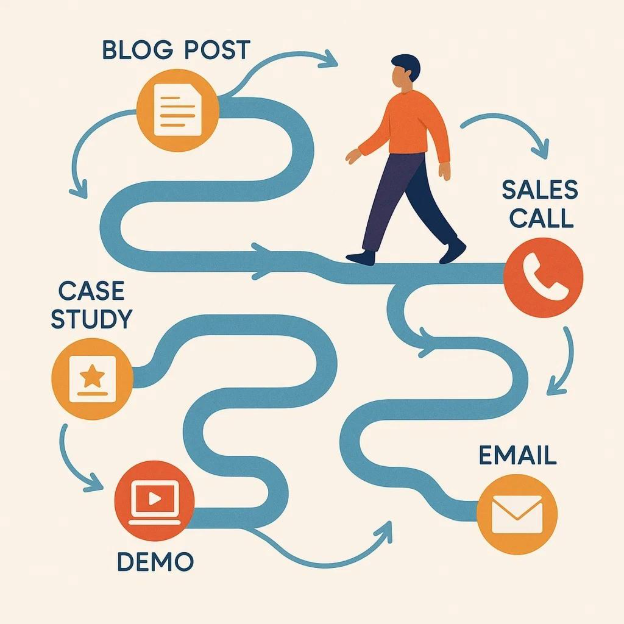
Why Lead Nurturing Still Matters (Even When You Think It Doesn’t)
Lead nurturing isn't just “nice to have”. It's often the difference between a quiet inbox and a closed deal. The buying journey rarely moves in a straight line. It slows down, loops back, and stalls. Sometimes it restarts entirely.
Buyers have reasons to hesitate. They've been pitched tools that overpromised and underdelivered. They’ve booked demos that felt personal until the follow-up went silent. So, when they sense rushed, one-size-fits-all messaging, they opt out quietly.
Data suggests that nurtured leads are spent on average, 47% more. Whether that number is perfectly accurate across every vertical is debatable, but the principle holds: leads that aren’t nurtured tend to disengage. Or worse, they forget you entirely.
In fact, it could be argued that poor nurturing costs more than poor lead generation. At least bad leads don’t drain your funnel slowly. Untouched leads do.
Goals of Lead Nurturing:
Lead nurturing isn’t about pushing leads through a pipeline. It’s about meeting them with the right message at the right moment and earning their attention without demanding it.
Educate:
Start by helping leads understand the problem, not just your product. Education builds context. Context builds credibility.
Build trust:
Trust doesn’t happen with a single click. It’s formed across moments that feel useful, relevant, and real.
Preempt objections: Great nurturing answers questions before they’re asked. Not with fluff—but with thoughtful, credible content.
Engage:
There’s a fine line between persistent and annoying. Respect it.
Think beyond the sale:
The goal isn’t just to convert, it’s to retain. Post-purchase nurturing is where long-term value lives.
Reduce churn before it starts:
Sometimes your warmest future lead is cooling current customers. Don’t let them drift unnoticed.

Lifecycle and Stages of the Buyer’s Journey
Marketers still cling to the “funnel” because it’s simple and straightforward. But in practice, modern buyer behavior is nonlinear. It’s rarely a clean drop from awareness to purchase; it’s a recursive loop of evaluation, distraction, and re-engagement.
Let’s walk through the real dynamics of the journey:
1. Awareness Stage: Problem Identification Begins
At this stage, the buyer is either unaware or only partially aware of a challenge, inefficiency, or unmet need. They're not solution-seeking yet. They're browsing, not benchmarking.
Primary Buyer Intent:
Seeking insight, clarity, or confirmation that the problem exists or matters.
Effective Content Types:
- Top-of-funnel blog articles (optimized for informational search intent)
- Educational explainer videos or micro-learning series
- Market trend reports or early-stage white papers
- Interactive landing pages with light-touch CTAs (like gated templates)
Automation Tactic:
Trigger nurture workflow post-content download. Keep it low-friction and value-first resource roundups, no hard questions.
Marketing Tech Tip:
Map these users to your CRM with an “Awareness” lifecycle stage and minimal lead scoring. Focus on first-party intent signals (scroll depth, time on site) to gauge engagement quality.
2. Consideration Stage: Active Problem-Solution Exploration
Here, buyers define their needs and compare options. They’re conducting mid-funnel research to evaluate approaches, tools, or service providers. Competitive content becomes key.
Primary Buyer Intent:
To understand different solution categories and identify which might solve their problem.
Effective Content Types:
- Comparison guides (vendor-neutral or subtly biased)
- Buyer’s guides tailored by industry or persona
- Case studies, use case videos, and success stories
- ROI calculators or interactive assessments
Automation Tactic:
Behavioral segmentation based on viewed assets (e.g., pricing pages, comparison sheets) should trigger mid-funnel email sequences or retargeting ads designed to reduce ambiguity.
Marketing Tech Tip:
Deploy lead scoring here. Prioritize engagement-based scoring (PDF downloads, time spent on high-intent pages) and push MQLs to CRM for sales alignment checkpoints.
3. Decision Stage: Risk Mitigation and Final Validation
The buyer is nearing commitment but needs to eliminate friction. At this point, uncertainty, inertia, or internal stakeholder objections often delay action, rather than a lack of interest.
Primary Buyer Intent:
To validate the final choice and mitigate the risk associated with the purchase decision.
Effective Content Types:
- Personalized outreach (email, calls, or direct messages)
- Final FAQ documents or objection-handling pages
- Live demos, consultation offers, or free trials (where relevant)
- Promotional nudges like time-bound offers or limited bonuses
Automation Tactic:
Trigger real-time sales alerts based on high-intent behavior (e.g., return visits to pricing or contact page) to initiate human follow-up.
Marketing Tech Tip:
This is where sales enablement tools (like Calendly integrations, CRM activity sync, or warm-lead routing) become crucial. Using workflows to route these leads to reps within minutes, not hours.
4. Bonus Stage: Post-Purchase (Often Forgotten)
The journey doesn’t end at the sale. For long-term value (especially in subscription models or high-LTV industries), post-purchase nurturing is essential.
Tactics include:
- Onboarding flows
- Usage tips and how-to content
- Feedback collection loops
- Referral or upsell campaigns

10 Lead Nurturing Tactics That Deliver
Not every tactic works every time. And perhaps it never happened. What we call “lead nurturing” is often more chaotic than strategic, more adaptive than formulaic.
These ten tactics, drawn from real-world execution (and occasional missteps), may offer proper direction, but rarely certainty. It could be argued that their success hinges less on the tool itself and more on how and when it’s used.
1. Welcome Sequences That Don’t Smell Like Automation
Let’s be honest: most welcome emails feel as personal as a parking ticket. And yet, this initial exchange still holds promise. A well-crafted sequence, triggered by real user behavior and informed by lead source, can establish tone, relevance, and intent. The goal isn’t just to say “Hi,” it’s to start the conversation gently, and they may not realize they’ve joined.
Some practitioners swear short sequences with soft calls to action (CTAs); others lean into storytelling or brand positioning. There’s no definitive right here, only the clear wrong of sounding like a robot.
2. Segmentation That Understands People, Not Just Profiles
While segmenting by industry, title, or company size remains common, such approaches are increasingly perceived as incomplete. Behavior, what someone does, may say more than static attributes ever could.
It appears that blending firmographic data with activity-based signals (e.g., webinar engagement, whitepaper downloads, session depth) yields far more contextual targeting.
That said, over-engineering segments can become a trap. Simplicity often prevails when complexity introduces noise rather than clarity.
3. Lead Scoring That Reflects Reality, Not Just Activity
Assigning numeric scores to human interest may seem scientific, but it is often anything but. The danger lies in mistaking activity for intent. A lead that opened four emails might be curious; one who requested pricing and visited the comparison page three times? Likely closer to a decision.
It is believed that the best models combine both implicit behaviors and explicit qualifiers, then revise those models periodically. Otherwise, the scoring becomes dogma rather than diagnosis.
4. A/B Testing Only When You Have Something Worth Testing
There's a strange comfort in testing subject lines and button colors. It feels like doing the work. But is it? Unless your traffic volume supports statistical significance (and unless the test reveals something meaningful), you may be merely rearranging furniture in a house no one visits.
Instead, it may be more fruitful to test deeper concepts: Does reframing your value proposition shift conversions? Does a shorter funnel reduce drop-off? These are harder to test but matter more.
5. Sales Triggers You Agree On (Not Just Assume)
One of the quiet tensions in B2B funnels is the handoff moment when marketing declares a lead “ready” and sales raise an eyebrow. Too often, readiness is defined in isolation, using arbitrary point thresholds or engagement assumptions.
A more thoughtful approach would involve mutual definition. What do salespeople really need to know before making a call? Have they visited the pricing page? Download a buyer’s guide? Or are we just excited that they opened three newsletters?
6. Lifecycle-Based Workflows
Context is everything. You wouldn’t explain how to install your product to someone still figuring out what your product does. And yet, such a mismatch occurs frequently. One-size-fits-all nurturing persists, especially in early-stage automation setups.
Mapping user journeys to distinct lifecycle stages, awareness, consideration, decision, and post-purchase, enables more empathetic communication. And it respects the most overlooked fact in marketing: people change.
7. Social Proof That Sounds Like Someone You’d Trust
Most testimonials don’t convince anyone. They’re vague, sanitized, and strangely non-human. “This tool changed my workflow forever!” doesn’t sound like something an actual CFO would say.
If you’re going to include social proof (and you should), make it real: specific outcomes, clear metrics, human language.
Also, oddly overlooked. Include who is speaking. Title. Company. Industry. The more they look like your ideal customer profile (ICP), the more weight their words carry.
8. Time-Limited Offers That Respect Intelligence
Deadlines work until they are finished. If your “last chance” discount resurfaces every three weeks, your audience catches on. Urgency must be rooted in reality: fiscal cycles, onboarding milestones, and real business events.
Savvy marketers use contextual urgency, like rewarding engagement (e.g., “You completed your onboarding checklist”. Want 20% off your annual plan?”). Otherwise, you’re just building immunity to urgency.
9. Drip Campaigns That Solve, Not Sell
Drip sequences are often treated like prolonged ad campaigns, with each email serving as a new pitch. However, they may work better when treated as a slow-release knowledge base. Each email answers one question. Solving one friction point.
It is suggested that usage-based content (e.g., “Most teams like yours activate this feature first…”) outperforms generic benefit lists. Educate first. Trust (and conversion) tends to follow.
10. Abandonment Nudges That Don’t Overstep
A trial user went silent. A lead filled 70% of your demo form and vanished. These are moments of maybe not no. And your job isn’t to push, but to offer a reason to return. Gently.
Subtlety helps. Try: “Still exploring?” instead of “Last chance!” Or offer something helpful—an article, a feature video, a support link—without assumption or pressure.
Benefits of Automating Lead Generation and Nurturing
Higher Conversion Rates
Leads receive timely, relevant messages tailored to their journey, resulting in improved engagement and conversions.
Scalability
Automation platforms grow with you. Whether you’re handling 100 leads or 10,000, market automation ensures consistent quality and follow-through.
Time-Saving Features
From triggered emails to auto-scheduling social media posts, automation reduces hours of manual effort.
Consistent Messaging
Your branding, voice, and message remain consistent across every channel, touchpoint, and lead type.
Advanced Insights
Track open rates, click rates, lifecycle stages, and ROI with advanced analytics. Make data-driven decisions, not guesses.
Seamless Team Collaboration
Sales and marketing teams can view shared dashboards, automate lead assignments, and collaborate more efficiently on nurturing campaigns.
Troubles You’ll Probably Encounter Anyway
Even with well-structured workflows and advanced automation platforms, nurturing often deviates from the planned course of action. Certain pitfalls are expected, while others emerge from the very strategies intended to optimize engagement.
Below are four common challenges that often arise, regardless of experience level.
Oversimplified Segmentation
Relying exclusively on broad attributes, such as industry or job title, often results in generic messaging. While it may appear efficient, this approach overlooks the nuances that drive intent. Two decision-makers in the same role may behave entirely differently, depending on the company's maturity, internal goals, or current pain points.
In contrast, segmentation models that incorporate behavioral signals—such as content engagement, session depth, or product interactions—tend to produce more relevant, better-performing campaigns.
Automated Messaging That Feels Unnatural
Messages that lack a human tone often fail to resonate. Overly polished, formulaic copy tends to flatten the experience, making emails easy to ignore. While AI-assisted writing can improve efficiency, it risks diluting authenticity if not carefully reviewed and adapted.
Strategically introducing informal phrasing, varied sentence rhythms, and tonal shifts can help preserve the sense of a real conversation—one that feels written for the recipient, not at them.
Excessive Nurturing That Leads to Fatigue
To remain top-of-mind, it’s easy to over-communicate. But continuous messaging doesn’t always equate to increased engagement. Recipients may experience content fatigue or interpret frequent outreach as pressure rather than support.
There is growing evidence that well-timed pauses—and the deliberate use of silence—can preserve attention and improve long-term conversion rates. In some cases, a reactivation campaign sent after a quiet period may outperform regular check-ins.
Overreliance on Shallow Metrics
Open rates and click-through rates remain widely used benchmarks, but their correlation with qualified pipeline progression is limited. These surface-level KPIs may indicate interest, but not necessarily intent or readiness to act.
Effective lead nurturing requires a shift in focus from vanity metrics to deeper indicators of buying behavior. Monitoring actions such as product exploration, time spent on solution pages, or engagement with bottom-funnel content tends to provide a more reliable measure of lead quality.
Final Thoughts
Not everything that is scalable should be. Automation, for all its convenience, tends to flatten nuance. It delivers messages, yes, but does it provide meaning? Possibly. Though some might argue that lead nurturing isn’t about moving people along a funnel, but about not being forgotten while they figure things out. And that requires something automation rarely provides patience without pressure. Relevance without noise. A kind of quiet consistency. The truth is that most tools can be followed up with. Fewer can truly connect. And when trust is the goal, showing up isn’t enough. How you show up, that’s what lingers on.