Entity-Based SEO is more than just a tactic to rank highly on Google. It represents a significant shift in the way we interact with search engines. It calls for us to be more meticulous, truthful, and well-organized with our data. The transition from keywords to entities is a move toward a more human-centric web. It rewards depth, accuracy, and genuine expertise over clever word placement. As you move forward, ask yourself not what keywords you want to rank for, but what entity you want your brand to become. When you align your content with the way search engines actually think, the rankings, the traffic, and the trust will naturally follow.
Digital marketing has shifted under us, and a lot of people only noticed when their old playbook stopped delivering results. For years, SEO was mostly about matching “strings”: if you wanted to rank a phrase, you would stuff that exact wording into titles, headers, and every other paragraph. We obsessed over keyword density and treated Google like a simple pattern-matching machine that just needed to see the right terms in the right spots to reward a page.
However, as we navigate the complexities of 2026, search engines have moved away from simply matching text. We are now firmly in the era of "things, not strings." This is the core of Entity-Based SEO.
Google is not just skimming your copy for matching phrases anymore; it is trying to understand how your content plugs into a wider web of entities and ideas. If you are still optimizing around one-off keywords instead of the connections between those concepts, you are basically speaking a Search Engine Optimization dialect the current algorithm has already left behind.
This guide will walk you through how to evolve that approach into a semantic, entity-led framework that actually matches how modern search understands information.
Defining the Core: What Is an Entity in SEO?
To master this strategy, we must first define the term with precision. In the eyes of a search engine, an entity is a well-defined, unique, and distinguishable person, place, thing, or concept. Crucially, an entity exists independently of the language used to describe it, or the specific keywords used to find it.
Consider the entity "The Great Wall of China." It is a physical structure. Whether a user types "China's big wall," "Wanli Changcheng," or "ancient Chinese fortifications," the underlying entity remains the same. Google identifies this entity not by the letters in the search bar, but by its attributes: its location, its history, its length, and its relationship to the Ming Dynasty.
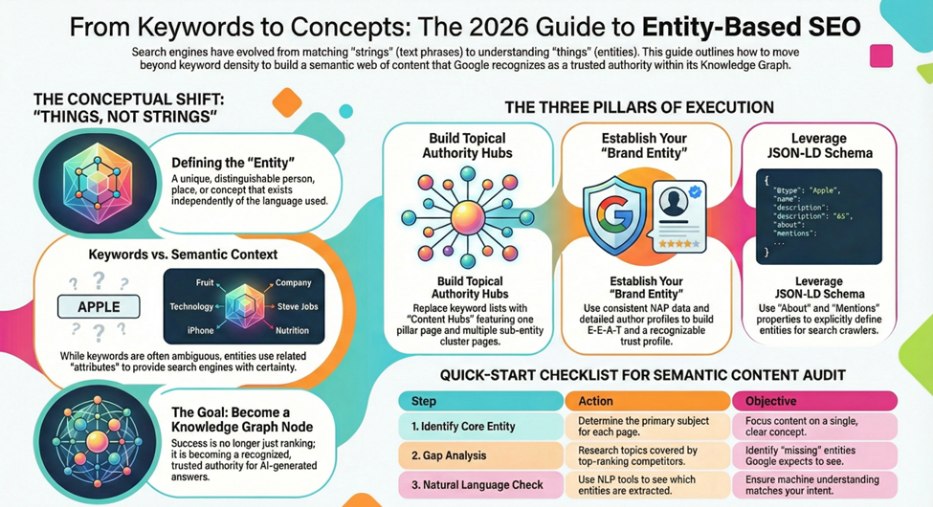
The Shift from Keywords to Concepts
Keywords are often ambiguous. Take the word "Mercury." Without context, a search engine doesn't know if you are interested in the planet, the Roman god, the chemical element, or the defunct car brand.
Entity-Based SEO solves this problem by surrounding a primary concept with "related entities." If your page mentions "orbit," "solar system," and "craters," Google’s algorithm uses Natural Language Processing (NLP) to confirm with high confidence that you are discussing astronomy. This removal of ambiguity is the primary reason why entity-focused sites often see more stable rankings than those chasing high-volume keywords alone.
The Foundation: Google’s Knowledge Graph and Vault
The backbone of this entire system is the Google Knowledge Graph. Launched over a decade ago, it has grown into a massive database containing billions of facts about entities and their connections.
When you see a "Knowledge Panel" on the right side of a search result, you are seeing the Knowledge Graph in action. It is pulling data from trusted sources like Wikipedia, Wikidata, and official government sites to present a summary of an entity.
In 2026, the goal of SEO is no longer just to "rank" a page. The goal is to become a recognized node within this Knowledge Graph. When Google identifies your brand or your content as a trusted authority on a specific entity, you become the "preferred source" for AI-generated answers and search summaries.
The Evolution: Why Traditional SEO Is No Longer Enough
To understand why we need entity-based strategies, we have to look at how Google’s "brain" has evolved through several major updates:
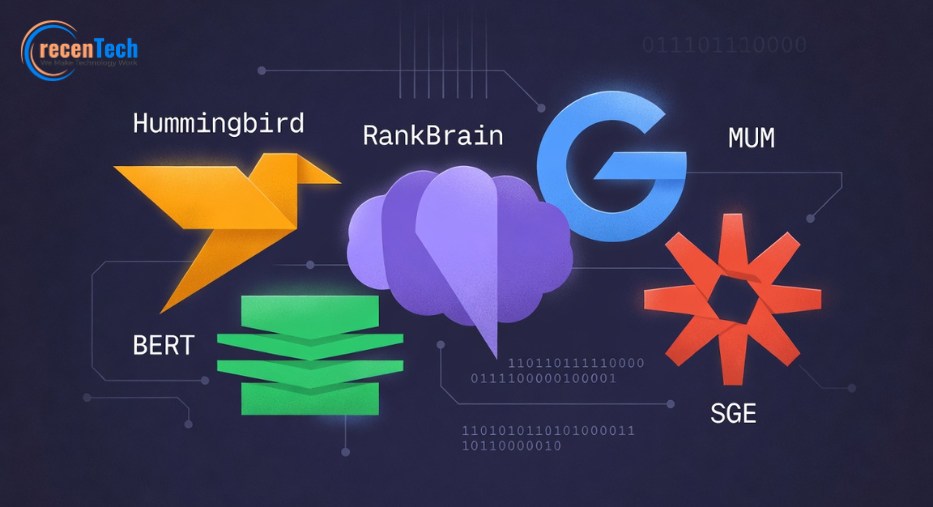
- Hummingbird (2013): This was the first major step toward understanding the "intent" behind a query rather than just the words.
- RankBrain (2015): Google introduced machine learning to help process search results. RankBrain could guess the meaning of words it didn't know by looking at similar concepts.
- BERT (2019): This update allowed Google to understand the context of words in a sentence by looking at the words that come before and after them.
- MUM (2021) and SGE (2024+): The Multitask Unified Model and Search Generative Experience represent the current peak of entity understanding. These models can answer complex questions by synthesizing information across multiple entities and even multiple languages.
In this environment, a page optimized for a single keyword feels "thin" to the algorithm. It lacks the semantic depth required to satisfy a sophisticated AI model.
The Three Pillars of Entity-Based Content Strategy
Moving toward an entity-based model requires a total rethink of how you plan your content calendar. You should move away from a list of keywords and toward a map of topical clusters.
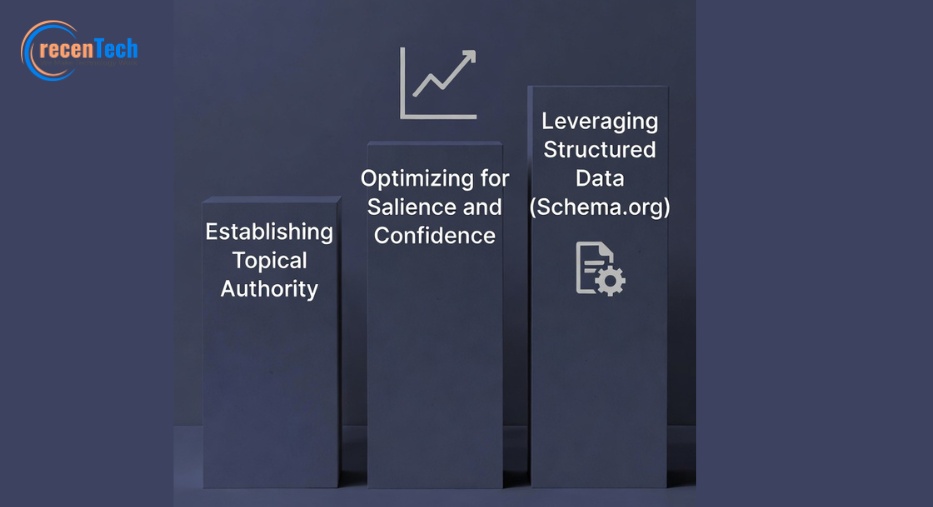
1. Establishing Topical Authority
Topical authority is the measure of how much a search engine trusts your site as an expert on a broad subject. To build this, you cannot simply write one great article. You must build a "Content Hub."
A Content Hub consists of a pillar page (the main entity) and several cluster pages (related sub-entities). For example, if your pillar page is about "Home Renovations," your cluster pages should cover:
- Kitchen Remodeling (Sub-entity)
- Structural Engineering Permits (Related concept)
- Sustainable Building Materials (Attribute)
- Cost Estimation for Local Markets (Contextual entity)
By linking these pages together, you create a semantic web on your own site. This signals to Google that you have "exhausted" the topic, making you a more reliable source than a competitor who only has a single blog post on the matter.
2. Optimizing for Salience and Confidence
Google uses two specific metrics when it analyzes the entities on your page: Salience and Confidence.
- Confidence: This is a score of how sure Google is that you are talking about a specific entity. You increase this by using clear, unambiguous language and citing your sources.
- Salience: This measures how important an entity is to the overall page. If you are writing about "Digital Marketing" but only mention "SEO" once in the final paragraph, the salience score for "SEO" will be low.
To rank for a topic, your primary entity must have the highest salience score, supported by a "vocabulary" of related entities that confirm the topic.
3. Leveraging Structured Data (Schema.org)
If content is the "what," Schema markup is the "how" for search engines. Structured data is a code format that tells Google exactly what it is looking at.
By using JSON-LD schema, you can explicitly define the entities on your page. For example, using the About and Mentions properties in your article schema allows you to tell the crawler: "This article is About Entity A (link to Wikipedia) and Mentions Entity B and Entity C."
This removes the guesswork for the search engine. It bridges the gap between human language and machine-readable data.
The Brand as an Entity: Trust and E-E-A-T
In 2026, Google treats brands and authors as entities. This is where E-E-A-T (Experience, Expertise, Authoritativeness, and Trustworthiness) becomes critical.
If your brand is a recognized entity, Google can connect it to your products, your reviews, and your social media presence. This creates a "trust profile."
How to Build Your Brand Entity
- Consistency is Key: Your brand name, address, and phone number (NAP) must be identical across your website, Google Business Profile, and social media.
- Detailed "About Us" Pages: This is one of the most important pages on your site. It should list your history, your mission, and, most importantly, the people behind the brand.
- Author Profiles: Every article should be attributed to a real person. That person should have a bio page that links to their LinkedIn profile and other articles they have written. This helps Google recognize the author as an "Expert Entity."
Strategic Internal Linking in a Semantic Web
The way you link your pages internally is a major signal of entity relationships. The old way of SEO involved "exact-match anchor text," where you would link the phrase "cheap flights" to your booking page every single time.
In a semantic strategy, you link based on conceptual relevance. If you are discussing "Hiking in the Alps," you should link to an article on "High-Altitude Nutrition." Even though the keywords are different, the entities are deeply related. This type of linking helps Google map the "distance" between concepts on your site, which in turn boosts your authority for the entire niche.
Conducting an Entity-Based Content Audit
If your traffic has plateaued, it is likely because your content lacks "entity depth." You can fix this by performing a semantic audit.
| Step | Action | Objective |
|---|---|---|
| 1. Identify the Core Entity | Determine the primary person, place, or thing for each page. | Focus on the content on a single, clear concept. |
| 2. Gap Analysis | Look at the top three ranking competitors. What related topics are they covering that you are not? | Identify the "missing" entities that Google expects to see. |
| 3. Natural Language Check | Use tools like the Google NLP API to see what entities the crawler is actually extracting from your text. | Ensure the machine's "understanding" matches your intent. |
| 4. External Linking | Link to high-authority, non-competitor sites (like Wikipedia or official studies) to define your entities. | Provide context and validation for your claims. |
The Role of User Intent in Entity Search
User intent is the "why" behind the search. In entity-based SEO, we categorize intent into four main buckets: Informational, Navigational, Transactional, and Commercial Investigation.
Google’s entity understanding allows it to match a query to an intent more accurately than ever. For example, if someone searches for "How to fix a leaky faucet," they are looking for a "Tutorial" entity. If they search for "Best plumbing services near me," they are looking for a "Local Business" entity.
Your content must match the entity type that Google associates with that intent. If the search results are full of videos, you should probably be creating a video entity to compete. If they are full of product listings, an informational blog post will struggle to rank regardless of how well it is written.
Optimizing for the Search Generative Experience (SGE)
As AI-driven search results become the norm, being a recognized entity is your only way to stay visible. AI models do not "crawl" the web in the traditional sense; they "ingest" it. They look for consensus across multiple trusted sources.
If five different high-authority sites all mention your brand as a leader in "Sustainable Packaging," the AI models will record that relationship as a fact. This is an "Off-Page Entity SEO." It is the process of building your reputation on third-party sites so that you become a core part of the AI’s knowledge base.
Advanced Technical Implementation: Beyond Basic Schema
To outperform, you must go beyond the basic Article or Organization schema. In 2026, sophisticated SEOs are using:
- SameAs Property: This links your entity to its corresponding page on Wikipedia, Wikidata, or LinkedIn. It is the digital equivalent of saying, "Yes, I am that John Doe."
- SubjectOf Property: This can be used to link a person's entity to a video or podcast where they were interviewed, further establishing their expertise.
- CollectionPage Schema: This is used for category pages to help Google understand the relationship between a group of related products or posts.
These technical nuances tell a cohesive story to the search engine. They take the "guesswork" out of the crawling process, allowing Google to index your relationships with 100 percent certainty.
Future-Proofing Your SEO Strategy
The future of search is conversational, visual, and highly personalized. Whether it is voice search through a smart speaker or visual search through Google Lens, the common denominator is the entity.
A voice assistant must negotiate a convoluted web of entities when a user asks, "Where can I buy a red dress like the one in this movie?" These entities include the film, the actress, the fashion trend, and local retail stock.
Elevate Your Digital Authority with Expert Strategy
Navigating the complexities of semantic search and the Knowledge Graph requires a partner who understands the deep mechanics of modern algorithms. To simply "write content" and hope for the best is no longer sufficient. If you want your brand to seem truly unstoppable in your industry, you need a strategy that is both technical and artistic. At Crecentech, we go deep on Entity-Based SEO, helping brands move past basic keyword charts into real topical authority that search engines recognize and reward.
From deep-dive semantic audits to the implementation of complex JSON-LD schema, we provide the technical expertise and strategic vision required to dominate search results in 2026 and beyond. Let us help you turn your website into a recognized expert in the eyes of both Google and your customers.
Conclusion
Entity-Based SEO is more than just a tactic to rank highly on Google. It represents a significant shift in the way we interact with search engines. It calls for us to be more meticulous, truthful, and well-organized with our data. The transition from keywords to entities is a move toward a more human-centric web. It rewards depth, accuracy, and genuine expertise over clever word placement. As you move forward, ask yourself not what keywords you want to rank for, but what entity you want your brand to become. When you align your content with the way search engines actually think, the rankings, the traffic, and the trust will naturally follow.