
Forget about being invincible; that is just amazing. The goal is resilience. It is not about dodging every single swing; it is about making sure that when a hit finally lands, it does not lay you out flat. Stop taking vendors at their word and start making them prove it, ask for SBOMs, and clear visibility into how their software is built. When you pair that kind of transparency with a solid handle on your own tech stack, you stand a much better chance of riding out whatever comes next.
It’s 2026, and honestly, trying to secure a business feels like you’re obsessively bolting the front door while unknowingly leaving the kitchen window unlatched for a contractor. You can blow your entire budget on top-tier firewalls and monitoring tools, but they do not count for much if an attacker can stroll in behind a trusted vendor's badge.
That is the terrifying reality of supply chain attacks. It is not about someone smashing through your defenses; it’s about someone poisoning the well you drink from. As we stare down the barrel of 2027, this isn't just "another cyber threat" to add to the pile. It’s the one keeping your CISO up at 3 AM, staring at the ceiling.
The Rising Threat of Supply Chain Attacks in 2026
The old adage "trust but verify" didn't just age poorly; it died. In today's climate, the mantra is closer to "never trust and verify until you're blue in the face." The sophistication we’re seeing now? It’s miles ahead of where we were even two years ago.
Why Supply Chains Are the New Battlefield
Think like a hacker for a moment. They’re capitalists at heart. Why spend months trying to crack one company's bespoke security system when you can hack a single software vendor and get the keys to 5,000 companies all at once? It’s simple economics.
- The Domino Effect: Break into one Managed Service Provider (MSP), and you’ve suddenly got access to everyone they manage. It’s a cascade of chaos.
- The "Trojan Horse" Reality: Companies whitelist software from vendors they know. Attackers love this. They hitch a ride on that trust, slipping malware past the guards because, hey, it looks like a legitimate update.
- AI is speeding things up: Bad actors are using Generative AI to scan code dependencies faster than any human team could ever hope to patch them. It is an arms race, and they’re sprinting.
Key Statistics You Cannot Ignore
I do not like throwing numbers around just to scare people, but sometimes the data screams louder than words.
- It's getting worse: Frequency hasn't just ticked up; it’s practically doubled since late '24.
- The bill is huge: We're looking at a global cleanup cost north of $60 billion by the time 2026 wraps up. That is not a pocket change.
- The blind spot: Here’s the kicker, over 60% of businesses basically admitted they have no idea what their vendors are doing regarding security. They’re flying blinds.
Anatomy of a Modern Supply Chain Attack
To stop these guys, you have to understand how they work. And honestly? It’s usually one of three ways. They don't reinvent the wheel; they just find new ways to break it.
1. Software Dependency Compromise
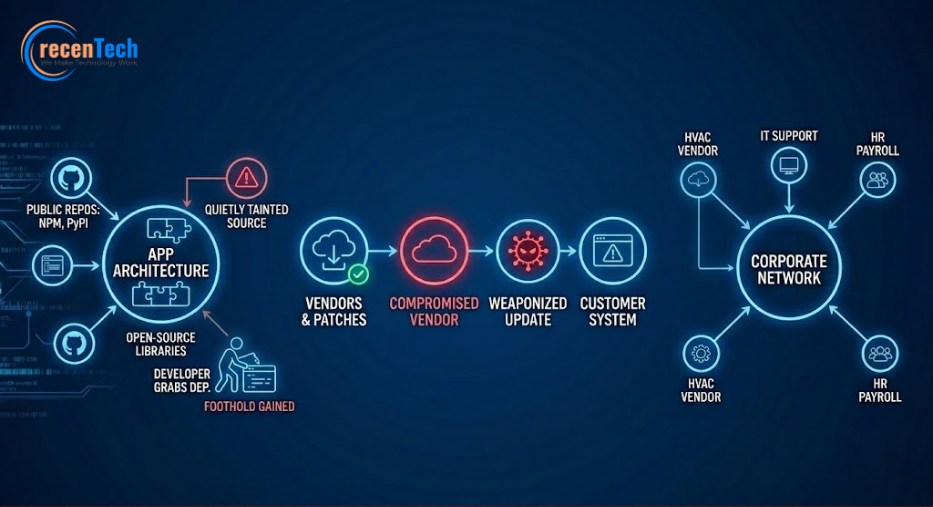
Modern apps are built like Frankenstein’s monster; stitched together from bits and pieces of open-source code. Maybe 80% of your code wasn't even written by your team. Attackers know this. They quietly taint the source, slipping malicious code into public repositories like NPM or PyPI. A developer grabs what looks like a harmless dependency to move faster, and suddenly that “time-saver” is a foothold for an attacker inside your system.
2. The Update Mechanism Exploit
This kind of attack is brutal because it punishes you for following best practices. You ship what you think is a routine security patch to close a hole, but if the vendor is already compromised, that “update” becomes the way in. You are inviting the threat through the front door by trusting a weaponized update that was tampered with long before it reached you.
SolarWinds became the textbook example of this supply chain backfire, and newer campaigns in 2026 are following the same playbook with even more precision and scale.
3. Third-Party Vendor Access
How many vendors have remote access to your network right now? HVAC maintenance? IT support? HR payroll systems? If their security is garbage, your security is garbage. Hackers ride their credentials straight into your servers like they own the place.
Real-World Incidents Shaping the Industry
| Incident Type | What Actually Happens | The Fallout |
|---|---|---|
| CI/CD Pipeline Attack | They sneak bad code into the automated build process. | The app gets signed and trusted, but it’s rotten on the inside. |
| Open-Source Poisoning | Hackers take over a bored developer's abandoned project and add malware. | Suddenly, millions of servers using that "safe" library are exposed. |
| Vendor Ransomware | A critical supplier gets locked up by ransomware. | You’re fine, but you can’t ship the product because your logistics software is dead. |
Strategic Defenses: How to Protect Your Business
Okay, enough doom and gloom. How do we actually fight this? Hint: You can’t just build higher walls. You need to start checking everyone’s ID, even the people you think you know.

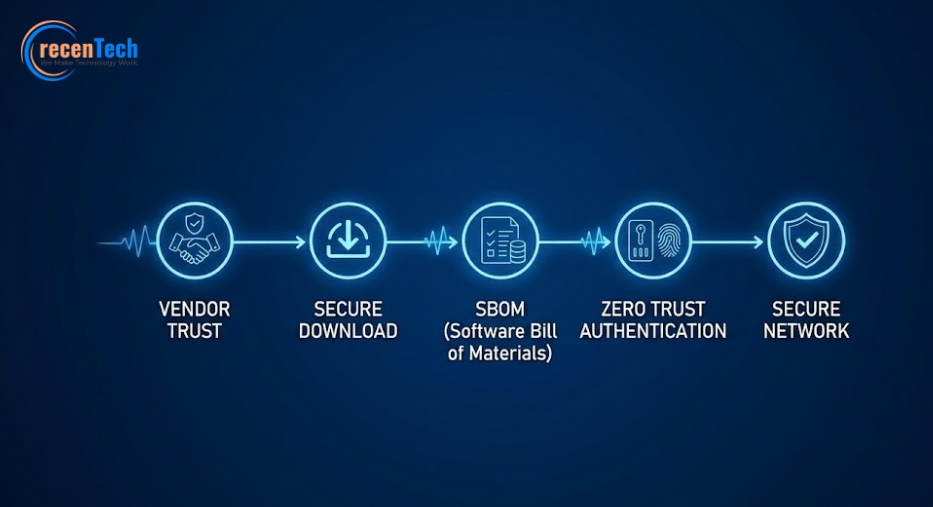
Implement a Zero Trust Architecture
Zero Trust sounds like a buzzword, I know. But it’s actually a survival strategy. It basically means assuming you’ve already been breached.
- Least Privilege: Give people (and vendors) the bare minimum access they need to do their job. Not a byte anymore.
- Chop it up (Micro-segmentation): Don’t have one giant network. Slice it into tiny, isolated zones. If a vendor tool goes rogue, make sure it’s trapped in a box and can’t touch your crown jewels.
- Never stop checking: Don’t just check credentials. Watch behavior constantly. If Bob from accounting suddenly tries to access the server room at 4 AM, lock him out.
Demand a Software Bill of Materials (SBOM)
Think of this as a nutrition label for your software. An SBOM lists every single ingredient, every library, every snippet of code.
- Why bother? Remember Log4j? The panic? If you have an SBOM, you search the list, see if you’re using the bad ingredient, and fix it. No more guessing games.
- Do this now: Don’t sign a contract for new software unless they provide an SBOM. Make it a dealbreaker.
Strengthen Third-Party Risk Management (TPRM)
Your security ecosystem is fragile. It’s only as strong as that one vendor who still uses "Password123."
- Audit them: And I don't mean a multiple-choice questionnaire they fill out once and forget. I mean real, semi-annual audits.
- Sync your watches: If they get hacked, you need to know them immediately. Not next week. Ensure their incident response plan talks to yours.
- The "What If" plan: If a key vendor vanishes tomorrow, do you go out of business? Have a backup plan. Always.
Secure Your CI/CD Pipelines
For the tech-heavy crowds, your CI/CD pipeline is on the factory floor. Keep it clean.
- Sign everything: Code signing is non-negotiable. It proves that the code on the server is the same code your developer wrote.
- Scan on entry: Set up automated scanners that check for vulnerabilities every time someone hits "commit." Catch it before it goes live.
The Role of AI in Supply Chain Defense
As we march toward 2026, AI is a bit of a double-edged sword. It’s the weapon and the shield.
- Predicting the future: We’re seeing AI tools now that can look at global chatter and predict which open-source libraries are about to get hit. It’s like weather forecasting for malware.
- Spotting the weird: AI-driven endpoint detection acts like a digital bloodhound. It notices the weird stuff humans miss, like a calculator app suddenly trying to talk to an IP address in a different country.
Why Professional Management Matters
Look, trying to handle this in-house is a nightmare for most SMEs. You’ve got a business to run; you probably don't have time to monitor 5,000 software dependencies and badger 50 vendors about their security patches. It’s exhausting, and frankly, it’s dangerous to do it halfway.
Partner with Crecentech for Robust Security
This is where the rubber meets the road. Navigating this mess requires eyes on the glass 24/7. At Crecentech, we live and breathe Managed IT Services. We don't just "monitor" things; we obsess over them. From relentless vendor risk assessments to locking down your endpoints with Microsoft Intune, we build the kind of shield that actually holds up under pressure.
Don't let a sloppy vendor be the reason your business hits a wall. Let us handle the paranoid "verify" part of the equation so you can get back to growing your company. Contact Crecentech today, and let’s lock those back windows before the storm hits.
Conclusion
At the end of the day, supply chain attacks prove just how fragile our connected world really is. We rely on each other, and attackers exploit that. It turns our partnerships into liabilities. But here’s the thing: you can’t retreat into a cave. You have to keep doing business.
Forget about being invincible; that is just amazing. The goal is resilience. It is not about dodging every single swing; it is about making sure that when a hit finally lands, it does not lay you out flat. Stop taking vendors at their word and start making them prove it, ask for SBOMs, and clear visibility into how their software is built. When you pair that kind of transparency with a solid handle on your own tech stack, you stand a much better chance of riding out whatever comes next.
By 2030, the organizations still in the game will not be the ones treating security like a box-ticking exercise. They’ll be the ones that treat it as mission-critical infrastructure, the thing that helps get revenues consistently and keep the doors open.