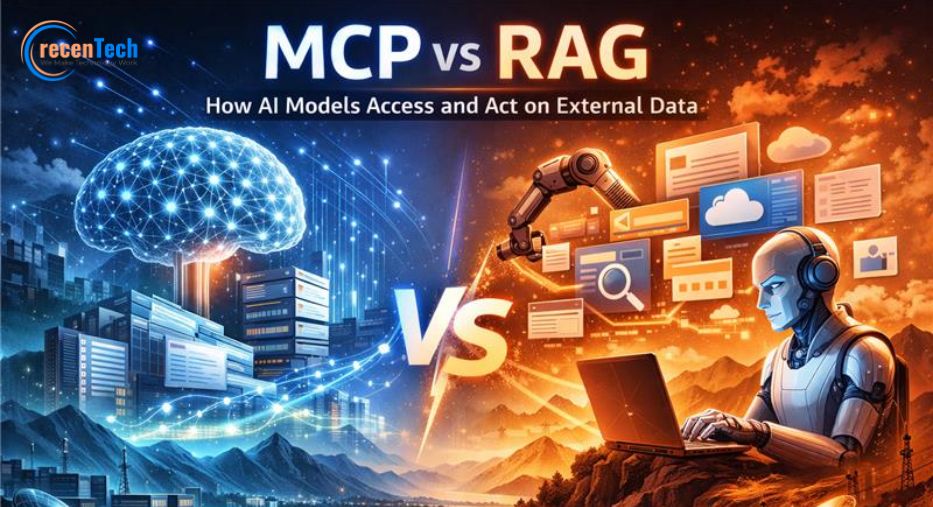
The debate over MCP vs RAG is ultimately a sign that the AI industry is maturing. We are moving away from the era of "talking" to machines and into the era of "collaborating" with them. RAG is the memory that gives the AI a past; MCP is the interface that gives the AI a future where it can actually impact your workflow.
The hype surrounding artificial intelligence has shifted. We’ve stopped gasping because a chatbot can rhyme or summarize a boring PDF without making up half the details. It is 2026, and those parlor tricks do not move the needle anymore.
When we look at MCP (Model Context Protocol) vs RAG (Retrieval-Augmented Generation), the real fight is not about how much information a model has stored in its head. It is about whether that model can actually roll up its sleeves and finish a task. We have moved past the "knowledge" phase and straight into the "execution" phase.
For the last few years, if you wanted an AI to know your company's data, you built a RAG pipeline. It was the standard. But as we try to build actual AI agents that can use tools, the limitations of that "read-only" approach are starting to hurt.
The Model Context Protocol (MCP) has entered the chat, not necessarily to kill RAG, but to give AI the hands it has been missing. If you are building for the future of enterprise automation, you need to understand which tool fits which problem.
The Old Guard: Why Retrieval-Augmented Generation Still Holds the Crown for Knowledge
To understand the shift, we have to look at what Retrieval-Augmented Generation actually does. Think of RAG as an open-book exam for a very smart student. The AI doesn't have your company's private manuals or last week’s sales reports in its long-term memory. When you ask it a question, the RAG system runs to the library, grabs a few relevant pages, and hands them to the AI to read before it answers.
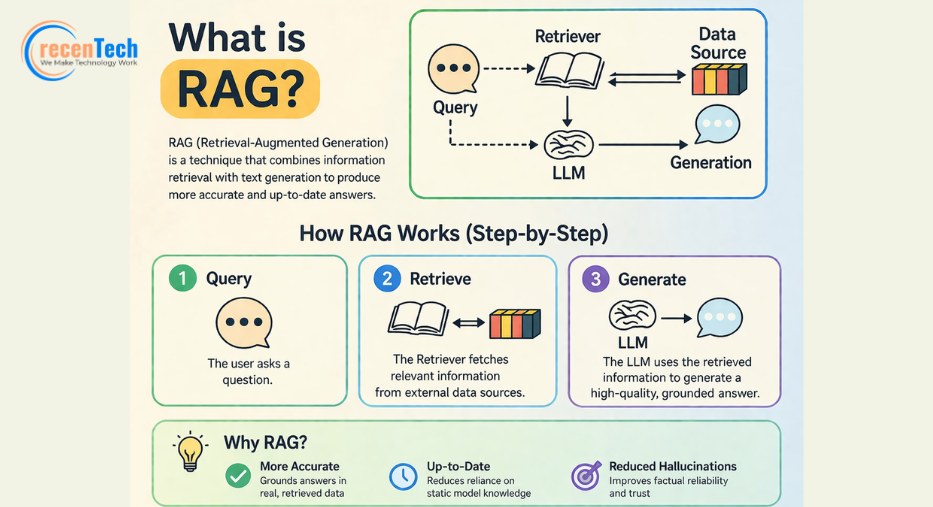
How RAG Keeps AI Grounded
The beauty of this system is that it kills hallucinations. By forcing the model to look at a specific set of "vectorized" data chunks, you ensure that it doesn't just start guessing. This has made RAG the go-to for customer support bots and internal wikis. If the answer isn't in the provided text, the model can be told to simply say, "I don't know," rather than making a believable lie.
The Problem with the Librarian Approach
The issue is that RAG is fundamentally passive. It is a "read-only" architecture. You can ask a RAG-powered bot what your current inventory levels are, and it will find the document and tell you. But it cannot go into your ERP system and order more stock. It is stuck in the library. If your goal is AI data integration that actually changes things in the real world, RAG starts to feel like a very smart person with their hands tied behind their back.
The New Player: What is the Model Context Protocol (MCP)?
If RAG is a librarian, the Model Context Protocol is a universal remote for the digital world. It is an open-standard protocol designed to let AI models connect directly to external tools and data sources without a million custom-coded bridges.
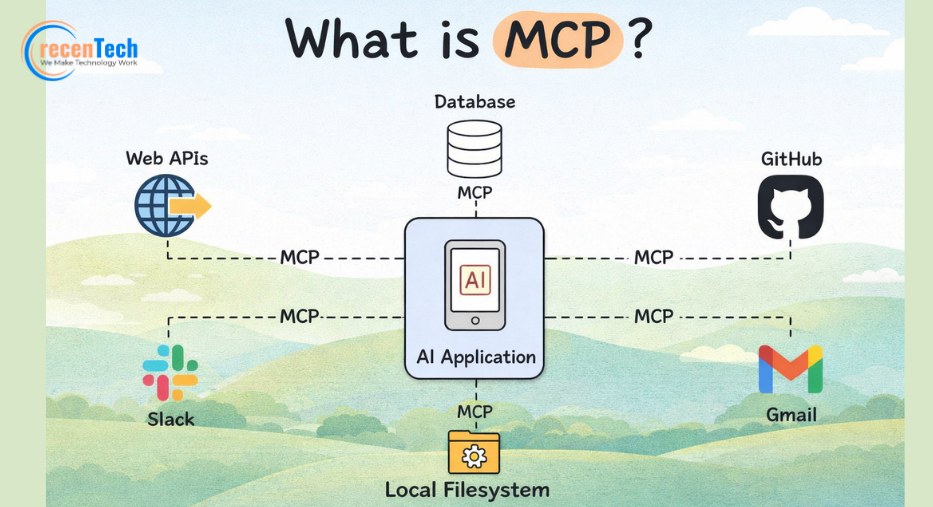
Before MCP, if you wanted your AI to talk to GitHub, Slack, and your local SQL database, you had to write a unique integration for every single one. If you decided to switch from one AI model to another, you often had to redo that work. MCP standardizes the "plug." It tells the model exactly what a tool can do and how to use it in a language the model already understands.
Turning AI into an Active Participant
The biggest shift with MCP is that it allows the AI to understand the "schema" of your systems. It isn't just reading text snippets. It can understand that a database has tables, columns, and relationships. It can navigate a file system. This allows the model to act. Instead of just telling you that a customer is unhappy, an MCP-enabled agent can check the shipping status, see the delay, and trigger a discount code in your billing software.
The "Universal Plug" Philosophy
The genius of MCP is that it moves the complexity away from the AI model. You build an MCP server once for your specific database or tool. Once that is done, any AI that speaks about the protocol can immediately use it. This lowers the barrier to entry for complex AI agent with external tools significantly. You stop building "bots" and start building "capabilities."
MCP vs RAG: A Side-by-Side Comparison for Developers
While they can work together, they solve very different technical hurdles. Understanding the "why" behind each helps you avoid over-engineering for your solution.
| Feature | Retrieval-Augmented Generation (RAG) | Model Context Protocol (MCP) |
|---|---|---|
| Focus | Memory and Knowledge | Action and Interaction |
| Data Type | Static, vectorized text chunks | Dynamic, live system access |
| System State | Ignores the "state" of the system | Can interact with and change system state |
| Best For | FAQs, Wikis, Policy Documents | Coding assistants, ERP updates, active agents |
| Complexity | High (requires vector databases) | Moderate (requires an MCP server) |
Why "Knowing" Isn't Enough Anymore
We are seeing a massive trend toward "Agentic AI." A few years ago, we were happy with a chatbot that could explain a complex legal contract. Today, we want an AI that can read the contract, find the missing clauses, email the lawyer, and schedule a follow-up meeting.
RAG simply isn't built for that kind of workflow. If you try to force a RAG system to behave like an agent, you end up with a mess of "if-then" statements and fragile API calls that break every time the model is updated. MCP is designed for this exact scenario. It allows the model to "browse" it's available tools. It can say, "To solve this user problem, I first need to use the 'Read_Database' tool and then the 'Send_Slack_Message' tool."
The Context Window Struggle
There is also the issue of "context window" real estate. AI models can only "think" about so much information at once. RAG often stuffs the context window with thousands of words of text that might not even be relevant. MCP is more surgical. It allows the model to fetch exactly what it needs when it needs it, keeping the conversation lean and the costs lower.
The Reality of AI Data Integration in 2026
When we talk about AI data integration, we have to talk about security. Giving an AI model of access to your live systems via MCP sounds terrifying to most IT directors. If the model decides to delete a database or leak payroll info, who is responsible?
This is where the architecture of the protocol becomes vital. An MCP server doesn't just give the AI a blank check. It acts as a gatekeeper. You define exactly which "tools" the model has access to. You can give it a "read-only" tool for your sensitive financial data while giving it "read-write" access to your project management software. This "Least Privilege" approach is the only way enterprise AI will ever be truly safe.
RAG as the Foundation for Trust
Even with the rise of MCP, RAG isn't going anywhere. Why? Because you still need a way to feed the model, vast amounts of historical context that don't live in a structured database. If you have ten years of PDF reports, turning them into a RAG knowledge base is still the most efficient way to make that data searchable. MCP then becomes the layer that sits on top of that knowledge to take action based on what the RAG system finds.
Scaling AI Agent External Tools: The Infrastructure Problem
The biggest hurdle right now isn't the AI intelligence; it is the "plumbing." Every company has a different way of storing data. Some use modern cloud APIs, while others are still running critical business logic on a legacy SQL server in a closet.
Standardization through the Model Context Protocol is the only way we scale. If every company has to spend six months building a custom integration just to let an AI read their calendar, the "AI Revolution" will stall. MCP servers are becoming the "drivers" of the AI era. Just like you don't have to write custom code to make your computer talk to a new printer, you shouldn't have to write custom code to make an LLM talk to your CRM.
Managing Token Costs and Latency
One of the blunt realities of this tech is that it isn't free. Every time an AI "thinks," it costs money in tokens. RAG can be expensive because it often sends too much data to the model. MCP can be expensive because it might require multiple "calls" back and forth as the AI uses different tools.
To win in this space, businesses are looking at "Hybrid Architectures." You use a small, cheap model to handle the initial RAG search and then pass only the most critical information to a larger, more capable model that uses MCP to execute the final task. It is about being smart with your computing budget.
The Strategic Path Forward for Tech Leaders
If you are currently planning your AI roadmap, don't get stuck in a "this or that" mindset. The winners in the next three years will be the ones who build "Context-Aware Agents." These are systems that use RAG to understand the history and nuance of a problem but use MCP to reach out and actually solve it.
Step 1: Clean Up Your Data House
Neither of these technologies will save you if your data is a mess. If your internal documents are out of date, RAG will give you wrong answers. If your database schema is a tangled web of "Table_Final_v2" and "Table_New_Copy," an MCP server will just help the AI make mistakes faster.
Step 2: Identify Your "Action" Gaps
Where are your employees spending most of their time doing "copy-paste" work? That is your prime candidate for an MCP integration. If someone has to read an email, find a tracking number in a database, and then update a customer in Zendesk. You have a perfect use case for an AI agent that can act across those systems.
Step 3: Prioritize Secure Access
Start small. Don't give AI access to your entire cloud infrastructure on day one. Build a single MCP server for a non-critical task, like summarizing Jira tickets or checking out a public API. Once you have the security protocols figured out, you can start moving into more sensitive data silos.
How Crecentech Can Help You Build the Future
Getting your tech stack in order today isn't about bragging rights or being the first to try something new. You are setting the stage for a world where your AI tools stop being a novelty and start functioning like a reliable part of your crew. By getting the plumbing right now, you won't have to scramble later when everyone else realizes their AI is just a fancy chatbot that can't actually do any real work.
At Crecentech, we get our hands dirty with the backend infrastructure, so you don't have to. We take a hard look at your current data setup, tell you honestly whether RAG or MCP makes sense for your budget, and then we build the pipes to make it happen. We handle the messy server logic and the technical heavy lifting so you can stay focused on your actual revenue goals. Whether you need a massive knowledge base or a fleet of autonomous agents, we have the experience to bridge the gap between "cool tech" and "real business value."
Final Thoughts: Moving Beyond the Chatbot
The debate over MCP vs RAG is ultimately a sign that the AI industry is maturing. We are moving away from the era of "talking" to machines and into the era of "collaborating" with them. RAG is the memory that gives the AI a past; MCP is the interface that gives the AI a future where it can actually impact your workflow.
If you get the plumbing right today, you won't be the one left holding a useless chatbot while everyone else is running a fully automated crew. We have spent years listening to AI talk. Now, with the right protocols and architectures in place, it is finally time to let it work.
A smart model is useless if it is still locked in a room with no tools. If your AI can't touch your data in real-time, you are already falling behind.