CrecenTech creates digital experiences that captivate, convert, and enhance your brand apart from just developing websites. To achieve quantifiable business outcomes, every project we take on combines immersive design, flawless usability, and effective SEO techniques.
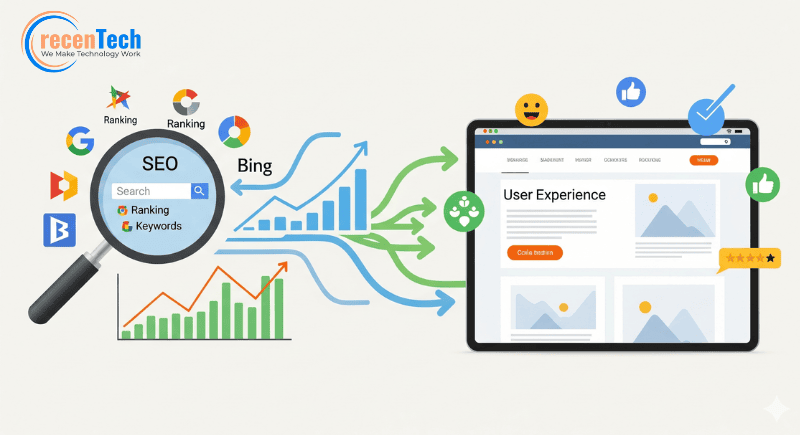
When businesses brainstorm ideas to climb search engine rankings, they mainly think about keywords, backlinks, and content optimization. Well, that matters, another key factor that is often overlooked is the user experience (UX). Google and other search engines are more intelligent than they ever are. They are assessing how users interact with your website, not just looking for keywords. A website that is quick, easy to use, and response will always be preferred over those with outdated designs.work is now directly SEO work, not a separate initiative.
Let’s understand how optimizing user experience directly improves search engine optimization (SEO) and how you can implement these techniques on your website.
Ways to Improve SEO Through Enhanced User Experience
Creating a website that people enjoy using is a crucial step before implementing SEO techniques. Your website will naturally rank higher and attract more active users when it offers a responsive user experience.
Improve Page Speed to Keep Visitors Engaged
One of the most essential elements for Search Engine Optimization and user experience is site speed. According to research, more than half of users get frustrated with a website right away if it takes longer than three seconds to load. This behavior affects your rankings as Google interprets it as an indication of a poor user experience.
To avoid such situations, you can try some quick fixes:
- Optimize and reduce the size of images.
- Make use of a trustworthy hosting provider.
- Avoid using complex plugins and scripts.
- Use a content delivery network (CDN) and cache.
Users will spend more time perusing your content, and you will rank higher in search results if your site loads quickly.
Final Thoughts
Teams that still treat SEO and UX as separate departments are usually duplicating work — the fixes overlap almost completely, and combining the effort saves real time.
Cross-Platform Compatible Website Design
With mobile-first indexing, Google gives your site’s mobile version priority to rank better and higher. Your content will appeal on all devices if it has a responsive, mobile-optimized design, Legible fonts, simple layouts, and buttons that are easy to navigate help keep users interested.
Think about mobile behavior patterns in addition to layout. On their phones, users frequently search for instant answers, location information, or a product that they can purchase right away. By making this process simple with quick loading times, calls to action, and easy-to-use navigation, you can enhance user experience while simultaneously improving your SEO techniques.
Do you want to implement cross-platform compatibility on your website? Contact us today and fix crucial issues that are limiting your growth.
Simplify Navigation for More Engagement
A website that is difficult to navigate can quickly lose visitors and search engine rankings. On the other hand, a clean, sensible structure makes it easier for users to find what they’re looking for and aids search engines in understanding the overall direction of your website.
Best Practices for Seamless Navigation:
- Keep your menu brief and easy to understand.
- Give menu items meaningful labels.
- Include internal links to guide visitors further into your website.
- Refrain from giving guests too many options.
Visitors don't have to second-guess where to go next when the navigation is clear. This increases time on site, decreases frustration, and lets Google know that your content is worthwhile and easy to use.
Optimize Content for Readability
Readers can instantly leave your website after facing walls of text, and poorly organized content. This will further increase your bounce rate. On the other hand, well-formatted, scannable content increases SEO performance and maintains user engagement.
- Implement content writing strategies to improve website readability.
- Make use of brief, informal paragraphs
- Use numbered steps or bullet points to simplify difficult concepts.
- Use descriptive headings (H2s and H3s) to create a proper content structure.
- Add visuals to your content, such as pictures, infographics, or videos.
User satisfaction, shares, and engagement are all increased by reading content. Additionally, structured content is easier for search engines to crawl, increasing the chance that it will rank for pertinent queries.
Focus on User Intent
Websites that align with user intent are rewarded by search engines. When someone searches for the best running shoes, they expect a product listing or clear guide rather than a generic landing page. Intent-driven design is important for ranking purposes. Conversion rates and search engine recognition can be greatly increased when you align your content to what visitors are searching for.
Consider the stage at which your users are. Are they doing research, comparing, or are they prepared to make a purchase? Make sure your pages provide the appropriate answers to their queries. This gives the user a positive experience while showing search engines that your content is authentic and well-structured.
Accessibility Build Trust & Search Value
Having an accessible website promotes inclusivity and audience trust, not just adherence to search engine algorithms. The experience of users can be enhanced by adding alt text to images, adopting relevant color schemes, and organizing content with distinct headings. SEO techniques also benefit from accessibility features as well.
For example, appropriate heading structure enhances content crawlability, and alt text makes your images indexable. All users will find it easier to navigate your site with these improvements, and search engines will also understand it better.
Prioritizing accessibility helps you reach a larger audience and shows search engines that your website provides a comprehensive and user-focused experience.
Supercharge Your SEO Efforts
A well-optimized website is the key to getting found by the right audience. SEO isn’t just about ranking for keywords; it is also about creating content and site structures that meet user intent, building authority in your niche, and ensuring search engines can easily crawl and index your pages.
From on-page optimization and technical SEO to strategic link-building and content marketing, a strong SEO strategy drives more organic traffic, higher engagement, and better conversion opportunities. And when your website also follows a structured design approach, you’re all set to skyrocket your search engine ranking and make your business stay ahead of the competition.
Boost your online visibility today. Partner with our SEO specialists at CrecenTech and watch your search rankings soar.
Reserve Your Spot on the First Page with CrecenTech
CrecenTech creates digital experiences that captivate, convert, and enhance your brand apart from just developing websites. To achieve quantifiable business outcomes, every project we take on combines immersive design, flawless usability, and effective SEO techniques.
- Engaging User Experiences: Clean, responsive designs that keep users coming back and interacting with your content.
- Easy and Quick Navigation: Mobile-friendly, lightning-fast websites that are effortless to explore.
- SEO-Driven Growth: Strategies that attract the right audience, improve rankings, and generate highly targeted traffic.
- Results That Matter: From boosting conversions to enhancing visibility, we focus on outcomes that accelerate your business growth.
We are the best in the industry because we have served thousands of customers, worked with global brands, and scaled up businesses from scratch. Trusted by businesses and celebrated online, our reputation reflects the growth we drive.
Don’t wait, reserve your spot on the first page today with CrecenTech and turn your website into a powerful growth engine.