In this environment, authority, clarity, and reliability are more valuable than ever. AI Mode Development is significant because it amplifies the need for brands to produce content that is not only discoverable but also directly usable by AI systems.
The SEO landscape is shifting yet again. Just when marketers and website owners had adjusted to Google’s AI Overviews, a new player entered the field: AI Mode. This advanced, conversational search feature is transforming how users interact with information and, in turn, how businesses should approach digital visibility.
AI Mode is not simply a minor feature or a “nice-to-have” add-on. It’s a full-scale reimagining of search interactions, combining conversational AI with task-oriented functionality. From planning trips to product research,
AI Mode can answer complex queries, interpret images, and even perform actions such as checking stock or guiding purchases. For SEOs, this signals a pivotal moment: adapting to AI Mode is no longer optional; it’s critical for maintaining relevance and visibility.
What Is Google AI Mode? (And Why It Matters for SEO)
AI Mode enables users to ask questions and engage in extended conversations with Google’s AI. Unlike traditional search, AI Mode breaks queries into multiple sub-questions, searches them in parallel, and synthesizes the information into human-like responses. This approach, internally referred to as “query fan-out,” allows for richer, more interactive results.
Users can upload images, request personalized recommendations, or even ask AI to complete transactions on their behalf.
AI Mode is currently live globally in English, with multi-language support expanding rapidly. Its agentic features, such as calling stores for stock information or completing purchases, are increasingly being rolled out, alongside ad integration.
When a user submits a query:
- Query Fan-Out: Google splits the question into multiple sub-queries.
- Parallel Processing: Each sub-query is analyzed and searched across indexed web content.
- Synthesis: AI synthesizes the results into a coherent, human-readable answer.
- Interactive Engagement: Users can ask follow-up questions, provide context, or upload images to refine results.
This process is far beyond what traditional search engines offer. AI Mode functions as a 24/7 research assistant, providing guidance and actionable recommendations in a conversational format.
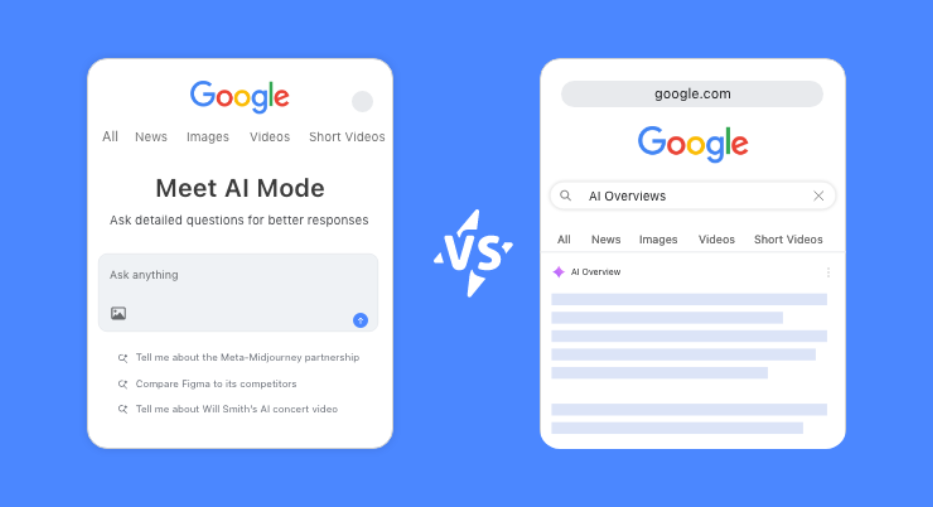
Google AI Mode vs AI Overviews: The Real Differences in 2025
Google has been experimenting with AI summaries in search for a while with AI Overviews, but AI Mode is a major evolution. Understanding the differences is critical for shaping your SEO strategy.
| Feature | AI Overviews | Google AI Mode 2025 |
|---|---|---|
| Placement | Summary at top of traditional results | Full separate tab – replaces blue links |
| Depth | Quick paragraph + links | Multi-turn conversation + agentic tasks |
| Click-through rate | Down ~34% on average | Only 6–8% of sessions click out (early data) |
| Ads & monetization | Yes | Yes – now in shopping/travel queries |
| Best for | Simple facts | Complex planning, shopping, and deep research |
Key Takeaways for SEOs:
- Traffic Patterns Are Changing: Informational sites may see fewer clicks, but the visitors that do reach your site are highly qualified.
- Content Must Be AI-Friendly: To be cited in AI Mode, your content needs to be structured, comprehensive, and ready for AI extraction.
- Revenue Over Raw Traffic: AI Mode often filters casual users. Focus on metrics such as conversions, engagement, and AI citations, rather than just pageviews.
This shift signals that traditional SEO is no longer enough. Your content needs to be clear, authoritative, and designed to answer queries that AI synthesizes and delivers directly to users.
How AI Mode Is Changing SEO Metrics: Traffic vs. Conversions
AI Mode is rewriting the rules of SEO. Traditional metrics like pageviews and click-through rate (CTR) are becoming less meaningful, while engagement, conversions, and AI citations are becoming the new indicators of success.
Why Traffic May Drop
- Informational queries are increasingly answered directly by AI Mode, leaving fewer clicks for websites.
- Early data shows only 6–8% of AI Mode sessions result in click-throughs, even for top-ranking content.
- Sites that relied heavily on informational traffic might see declines of 20–60% in visitors.
But Revenue Can Increase
- The traffic that does come through is highly qualified.
For example,
- NerdWallet saw a drop in traffic, but a 29% YoY increase in revenue, as AI-referred users were ready to convert.
- HubSpot lost some traffic but experienced 20%+ revenue growth, highlighting the value of high-intent users.
New KPIs for the AI Mode Era
- AI Citations: Track how often AI references your content in answers.
- Conversions & Engagement: Measure user actions, not just visits.
- Revenue per Visit: Focus on profitability and lead quality rather than raw traffic.
Actionable Tip: Use SEO analytics platforms that now offer AI-specific tracking (e.g., SEMrush AI Content Overview, Ahrefs AI Mentions) to monitor performance beyond traditional metrics.
How to Optimize Content for Google AI Mode Right Now
While the foundations of SEO, authoritative backlinks, crawlable content, and high-quality copy, remain relevant, AI Mode introduces new strategic considerations:
1. Prioritize AI-Ready Content
AI extracts information more efficiently from structured, well-formatted content. Key practices include:
- Scannable Layouts: Use bullet points, tables, headings, and numbered lists. AI tools prefer content that is easily parsable.
- Anticipate Follow-Ups: AI Mode often generates secondary questions. Include related content or FAQs on the page to address them.
- Comprehensive Coverage: One-page answers are no longer enough. Provide context, examples, and data points to cover the topic holistically.
2. Optimize Across Platforms
AI Mode does not operate in isolation. Users leverage a variety of AI tools such as ChatGPT, Claude, Perplexity, and Bing AI, all of which pull content from the open web. Consider these points:
- Create content that is universally authoritative to increase the likelihood of being cited across platforms.
- Focus on cross-platform consistency; structured content, metadata, and proper citations help AI confidently surface your content.
3. Leverage Structured Data
Schema markup now plays a critical role in visibility:
- Implement Product, FAQ, How-to, Article, and Review schemas to increase the probability of AI extraction.
- For e-commerce, Google Merchant Center integration is essential; AI Mode may surface product info directly in the sidebar, often bypassing traditional SERPs entirely.
4. Redefine Success Metrics
Traditional KPIs centered on traffic are less meaningful. Instead, measure:
- AI Citations: Monitor how often AI references content.
- Conversions and Engagement: Focus on high-intent visitors and the value of interactions.
- Revenue per Visit: Track profitability per session rather than raw volume.
Tools such as SEMrush, Ahrefs, and Surfer SEO are beginning to provide AI visibility analytics, making it easier for brands to measure their AI impact.
Your Google AI Mode Optimization Action Plan
Audit existing content for AI comprehension, readability and completeness. Track AI citations using analytics tools — being cited is often more valuable than an organic ranking position. Target zero-click wins by aiming to be the direct source of AI quotes. Invest in structured data across products, articles, FAQs and reviews. And monitor conversions, not just traffic.
Content That Wins Google AI Mode Citations
AI Mode favors content that is clear, authoritative, and actionable. The best-performing pages tend to have the following characteristics:
- Original Research or Proprietary Data: Unique datasets, experiments, and insights increase the likelihood of AI citations.
- First-Hand Experience: Case studies, reviews, and tutorials with real-world testing outperform generic summaries.
- Readable Structure: Short paragraphs, subheadings, bullet points, and numbered steps improve both human and AI readability.
- Task-Oriented Value: Content should help the user complete a task, not just provide information.
For e-commerce, completeness and accuracy are critical: product descriptions, availability, pricing, and structured metadata in Merchant Center are required for AI-driven recommendations to appear.
Your Google AI Mode Optimization Action Plan
- Audit Existing Content: Identify high-traffic pages and optimize AI comprehension. Check readability, structure, and completeness.
- Track AI Citations: Use analytics tools to see where AI assistants are citing content. Being cited is often more valuable than an organic ranking position.
- Target Zero-Click Wins: Aim to be the direct source of AI quotes, even if users do not click through. Structured, well-organized content increases this likelihood.
- Invest in Structured Data: Implement appropriate schema for products, articles, FAQs, How-to, and reviews to help AI parse and display your content effectively.
- Monitor Conversions, Not Just Traffic: Focus on qualified leads, engagement, and revenue from AI-driven interactions, rather than relying solely on pageviews.
The Future of Search
Search is evolving from click-based rankings to trust-based visibility. Websites that adapt will gain an advantage; those relying solely on traditional metrics may fall behind.
In this environment, authority, clarity, and reliability are more valuable than ever. AI Mode Development is significant because it amplifies the need for brands to produce content that is not only discoverable but also directly usable by AI systems.