Having a structured framework in place establishes consistent standards for managing security, scalability, compliance adherence, and operational transparency.
Multi-agent systems are rapidly becoming the foundation of enterprise automation. Instead of relying on isolated AI tools, organizations are deploying coordinated networks of AI agents that collaborate to execute complex workflows once entirely managed by human teams.
A multi-agent AI system creates a flexible workforce that can work well on its own and with humans in different departments. Although the introduction of these AI agents presents exciting opportunities, we also need to address significant issues like security, observability, governance, and compliance. These are areas where traditional IT systems need to change. The lack of standardized frameworks for enterprise AI agents leads to fragmentation, security vulnerabilities, and non-compliance.
Having a structured framework in place establishes consistent standards for managing security, scalability, compliance adherence, and operational transparency.
This guide explains the fundamental elements of AI agent frameworks, why businesses require them, and how various industries use them in practical operations.
The importance of orchestration for enterprise AI agents
When talking about AI agent frameworks, this applies to a single agent, including the reasoning core driven by an LLM and the middleware that grants it permissions and access to external sources.
A framework can also control its behavior, reasoning, decision-making, and interactions with humans and other AI agents. Conversely, AI orchestration frameworks manage multi-agent systems and ensure their cooperation, thereby improving business processes and workflows.
Careful AI agent orchestration is crucial for ensuring security, compliance, and alignment across the enterprise AI-agentic workforce, as well as maximizing performance efficiency.
Enterprise-grade multi-agent security

The risk profile for AI security and compliance increases based on the number of agents. Every agent has a different attack surface and access to various tools, APIs, and other external sources.
Agents frequently have permissions and functional hierarchies and exchange data with one another. If the system is sufficiently autonomous and accessible, poisoning or controlling one can have a devastating effect on the system. Feedback loops and other agent interaction vulnerabilities can be exploited to deplete resources or impair reasoning.
How to protect agents & their interactions
Agent Orchestration enables both agent and “team” level security. On a personal level, it is beneficial to ensure secure access to pre-approved tools and functions, provide clear prompts, redact unnecessary context for each agent, and set up resource quotas and limits for each agent.
Secure inter-agent interactions include measures to isolate suspect agents, data/decision lineage for each agent, attribute-based access control (ABAC), zero-trust communication between agents, and access isolation. By taking these steps, a security breach can be avoided, and its effects are lessened.
Consistent regulatory compliance
The main, overarching challenge in multi-agent systems is to interpret and enforce policies consistently across all agents.
Although LLM-level compliance adherence is beneficial, each agent's independence compromises the security layer, access to various data sources, and interpretation of policies and compliance requirements. Another challenge is managing compliance changes across agents, geographies, and purposes.
How policy-as-code keeps AI agents aligned with regulations
Using policy-as-code, a single source of truth that all agents refer to, in the orchestration layer, is one method of resolving the consistency issue.
This prevents individual agents from misinterpreting compliance, regardless of their external knowledge and reasoning sources.
The orchestration layer also manages industry, use-case, and region-specific compliance controls (CCPA, GDPR, HIPAA, and SOX). A number of security measures, such as access limitations, also aid compliance.
Tracking AI and Observing its Behavior
If multiple agents are working simultaneously, it gets to monitor. So, the businesses should monitor each agent’s actions and how they work together. Things like keeping track of their interactions, permissions, and dependencies within the overall system.
As individual agents' autonomy and external access levels increase, the complexity increases as well, because there are too many possible combinations of the decision flow. This increases the likelihood of erratic behavior.
How to gain visibility & traceability into agent operations
This is one of the reasons AI agent development frameworks create the foundation for optimal visibility across multi-agent systems and incorporate observability into individual agents.
It is necessary to monitor each agent's actions, including the external sources they consulted and the ways in which they prompted the LLM, to orchestrate the actions of numerous agents.
An agent's semantic understanding and decision-making are driven by an LLM that cannot be sufficiently probed to fully explain how or why it made a given choice or produced a given outcome.
However, tracking AI-specific metrics (latency, response quality, tokens), events, logs, and traces (collectively referred to as the MELT data) can provide enough insight into the behavior of individual agents and systems. Good orchestration techniques guarantee that thorough observability data is tracked and available, ideally in real-time.
Adaptive resilience & scalability
Multiple AI agents can actually work in harmony, often very differently from the routine chaos of human teams. Ironically, the resilience and scalability of AI agents are frequently harmed by this harmony and the ability of these agents to be so closely tuned to one another for an effective "whole."
Generally speaking, individual AI agents are adept at adjusting modifications in operating parameters. However, in multi-agent systems, they are limited by the needs of the agent in front of them in the workflow as well as the behavior of the agent in front of them. As a result, the team cannot benefit from single-agent adaptability.
Similar to this, a multi-agent system can be easily scaled for more of the same work, but when it is scaled for new tasks and workflow components, shared resources, hierarchies, flow, observability measures, and a number of other system components must be modified to accommodate scalability.
How to build flexible AI agent architectures
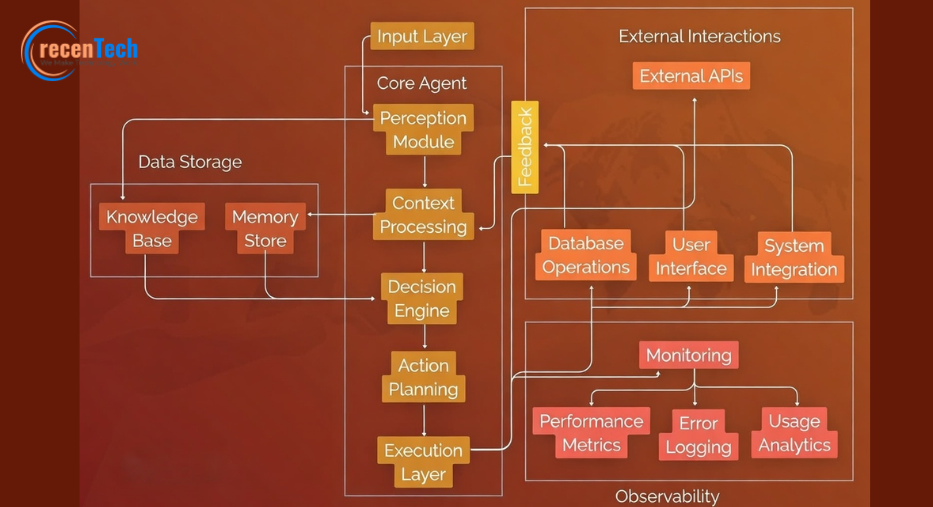
Frameworks for AI agents need to take these issues into consideration long before orchestration starts. This is accomplished by creating robust inter-agent contracts that close security and compliance gaps, which are made possible by modular agent builds, loose dependencies, and decoupled agent connections up and down the workflow.
This enables the addition of new agents without interfering with the current flow. Additionally, the systems become robust and readily scalable by establishing overarching control and data planes to which all agents can refer.
To keep agents sufficiently decoupled to respond to additions and changes, other orchestration techniques, such as employing asynchronous queues rather than synchronous chains, are helpful.
Structure of AI agent frameworks for enterprises
The components of an enterprise AI agent framework that are most frequently found are listed below. The following components aren't yet a standard "set," but as multi-agent systems proliferate and their structure is established, they will probably become essential pillars.
Agent registry
A common feature of enterprise AI architectures is agent registries. The phrase can refer to two different kinds of registries: one that maintains pertinent data on all AI agents that are deployed throughout the company, and another that is system-specific and maintains comprehensive data on all agents that are deployed in a multi-agent system.
Only high-level data about the agents, such as their name, status, owner, high-level purpose, policies they follow, and risk level, are stored in the organization's registry, also known as the agent catalog.
All this information, including dependencies, constraints, human-in-the-loop rules, external tools they can use, underlying models, and more, is available in system-specific agent registries.
In addition to providing performance, operational, cost, and other levels of visibility and control, system-level registries are crucial from the standpoints of governance and compliance.
Secure communication
Although securing inter-agent communication is a significant step in reducing system-wide vulnerability, it involves more than just shielding communication and data exchange from outside threats.
Data availability, integrity, and authenticity (of sender and recipient agents) are all involved. Because too many security layers can cause responses to be delayed, orchestration also has to balance security and performance.
But agents don't merely converse with one another. Additionally, they call APIs and establish connections with external data sources, which may necessitate the use of extra communication security measures.
However, there are other approaches as well, such as creating certification authorities (CA) that grant temporary certificates to agents that other agents can rely on. One of these is the zero-trust approach, in which every interaction between agents and external sources is verified.
Policy Enforcement
Three methods are typically used in an enterprise AI agent framework to enforce policy, whether it be internal or regulatory compliance:
Policy-as-Code (PAC)
Declarative policies are compared to each agent's policy-relevant requests or actions by a policy engine. Although it is much less flexible, a rule-based system can be used in place of a policy engine.
Human-in-the-Loop (HITL)
A human can enforce the policy on every decision or request in complex, high-risk, and ambiguous situations where policy interpretation cannot be left to AI.
Local Rules
These can be applied to specific agents or, at a finer level, to how they use and access their tools. Apart from HITL in workflows that aren't particularly compliance sensitive, the majority of intelligent agent architectures enforce policies by combining all three techniques.
Monitoring dashboard
Dashboards enable better orchestration decisions by enabling a wide range of stakeholders to observe the behavior, performance, and compliance of AI agents both individually and in a multi-agent system.
For granular ROI measurement, they can assist you in identifying bottlenecks, agents with the lowest/highest latency and throughput numbers, and the system's overall impact as well as the impact of each agent within the system.
Proactive course correction is made possible by data consolidation and visualization,
particularly in real-time.
However, data-to-dashboard pipelines and tracking logic are crucial to the impact and efficacy. It's crucial to identify the crucial variables because attempting to observe too many at once may obscure the important information. It's noteworthy that a small group of AI agents can collaborate to power this dashboard and produce insights, making the data easier for humans to understand.
Workflow orchestration
Multiple agents, each performing a single function or set of functions, can only manage slices of a complex workflow. According to your framework, the orchestrator agent or system is responsible for making sure that they all work together to finish the workflow or achieve its objectives.
All multi-agent systems, whether centralized or decentralized, have orchestration of some kind, including emergent, which may develop organically from several independent AI agents collaborating to achieve common objectives.
Even in diverse environments, workflow orchestration enables agents to effectively collaborate and maintain goal alignment. Experts and system architects who are knowledgeable about AI agent behavior and workflow design are needed to design and implement agent orchestration frameworks.
After it is put into place, the orchestrator agent/system takes over workflow coordination with HITL for specific functions; however, both performance and compliance are monitored.
Industry applications
Enterprise AI agent frameworks that are solid, well-thought-out, and closely monitored have the potential to revolutionize operations across almost every sector.
With little to no human involvement, they can supplement or even replace entire workflows, enabling previously unheard-of increases in productivity and efficiency as well as greatly increased scalability potential.
How different industries are using enterprise AI agent frameworks Healthcare
Strong policy-as-code implementation is necessary for healthcare multi-agent systems, particularly for the following use cases where agents and external sources exchange sensitive patient data:
Use cases and applications in the industry
Healthcare
Utilizing Policy-as-Code to manage agents for patient scheduling and EHR administration while ensuring strict HIPAA compliance.
Financial Services
Automating portfolio management and fraud detection with an emphasis on fiduciary responsibility and bias reduction.
Telecommunications
Improving operational effectiveness with automated maintenance procedures and network optimization.
Energy
Setting agents on operational nodes for real-time trading, failure prediction, and grid optimization.
Businesses benefit from AI agents when they operate in a controlled and organized environment. Systems without proper coordination can increase risks instead of improving efficiency.
A smart framework for enterprise AI agents combines different AI tools into a safe and effective automation platform. This platform is ready for real-world applications, not just for testing.