The future will be characterized by increasing customer scrutiny, regulatory scrutiny, and competitive pressure. Those who use KPIs as a learning system, not a scoreboard, will be the ones setting pricing trends, not responding to them. The leaders will set a new standard for fair, personalized, and profitable pricing.
Dynamic pricing is a gamechanger in the revenue generation of the travel industry. As of the early part of 2025, Delta was applying AI to price only three percent of its tickets. However, it plans to raise this to twenty percent by the end of the year, after successful test results.
Hotels using AI-based pricing solutions have seen RevPAR growth of up to eighteen percent and revenue growth of about fifteen percent, and eighty-two percent of hotel brands apply AI to pricing and revenue management.
The rising complexity of demand is one of the main factors. Customers are comparing prices on dozens of booking sites. Events can quickly change occupancy in a matter of hours, and competitors repriced their products instantly. None of these can be processed by traditional systems.
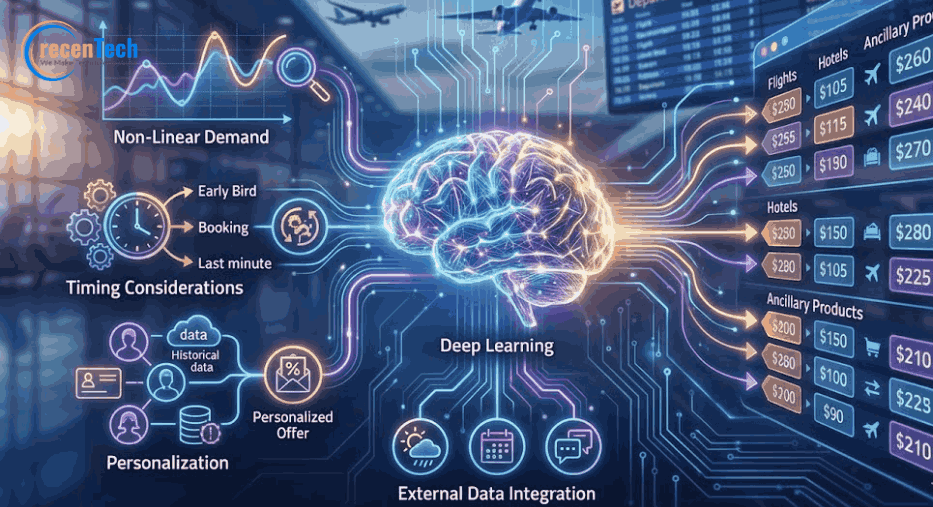
Deep learning enables real-time dynamic pricing by recognizing complex, non-linear relationships between demand, pricing, and other factors such as weather patterns or competitor sales.
The dynamic pricing software market grew to three billion dollars in 2024 and is expected to reach three and half billion dollars in 2025, mainly because of the significant investment made by the airline, hotel, and online travel agency industries in AI-based solutions.
How Deep Learning Drives Dynamic Pricing
Deep learning eliminates the need for hard-coded pricing policies in favor of models that can learn directly from complex data sets, making them effective in today’s ever-changing environment of travel demand.
- Identify non-linear demand: Neural networks identify underlying price-demand correlations and respond to market actions or market shocks.
- Address timing considerations: Prices are set over various booking horizons, recognizing the vastly different values of early and last-minute sales.
- Facilitate personalization: User behavior, loyalty program information, and historical data drives that optimize conversion and lifetime value.
- Integrate external data: Weather, events, and social phenomena are directly incorporated into pricing models.
Businesses such as Delta are already experimenting with AI systems that dynamically price and charge ancillary products, and this is just the beginning of how deep learning will transform pricing models in the real world.
Data Sources & Signal Engineering
Dynamic pricing requires accurate and constantly updated data. Deep learning networks work best when trained on varied and rapidly changing signals that better represent market realities. Successful travel companies create data-rich engines by using the following data:
- Transaction data: Bookings, cancellations, no-shows, and past prices that establish demand and elasticity.
- Distribution data: OTA market share, competitor prices, and GDS/ PNR data to track and analyze distribution and positioning.
- Digital behavior: Search for queries, browsing, and loyalty information that indicate real-time intent.
- External data: Events, weather, economic indicators, and social sentiment that predict future demand shifts.
- Update rate: Streaming data for real-time pricing, and batch processing for nightly model updates.
- Data quality & labeling: Clean and normalized data and properly labeled price-demand histories to avoid model drift and enhance precision.
Deep Learning Modeling Methods
There is no model that performs better than others for all pricing alternatives. Each approach has its own advantages in particular scenarios.
Time Series & Deep Learning
Approaches like Transformers, temporal convolution networks, and LSTMs are most appropriate for demand forecasting.
- These models are better than conventional ARIMA models in handling seasonality, day of the week, and the shifting booking curve.
- When hotels adopted advanced time series models, they reported a fifteen percent improvement in forecast accuracy over conventional approaches.
Hierarchical models
These models are most appropriate for inventory-type products like hotel rooms, airline seats, or car rentals.
- These models respect capacity constraints and capture relationships between categories, such as room type, property, and geography.
- When airlines adopted these models, they reported a seven percent revenue boost by aligning fleet-level and route-level forecasts.
Causal models/uplift modeling
Essential for modeling price elasticity while adjusting for confounding factors.
- Not only do you see correlations, but you actually measure the true effect of a price change on demand.
- Companies using causal models saw a nearly twenty percent year-over-year reduction in mispricing errors.
Reinforcement Learning & contextual bandits
Most applicable for real-time, adaptive pricing in high-speed environments.
- RL agents learn by trying out pricing actions, finding a balance between exploration and maximizing profits.
- Online travel agencies using bandits saw a ten percent conversion lift in a single quarter.
Hybrid Architectures
Forecasting and constrained optimization is the future of most enterprise systems.
- A forecasting model makes a prediction, and an optimization layer imposes constraints.
- Such a system can help executives deliver sustainable RevPAR growth without harming brand trust.
Deep Learning Architecture & Runtime
After the model has been trained, the next task is to transition from predictive data to an actual price that the customer views. This is where the runtime architecture becomes important.
1. Real-time inference layer
There is a flow of data from a feature store to the model, which produces a demand forecast or an elasticity indicator.
- A pricing strategy is applied to produce an actionable rate, which is guided by guardrails, the min/max values, brand considerations, or competitor alignment.
2. MLOps considerations
Modern leaders don’t ship models blindly. They use model versioning to track updates, conduct shadow testing to validate outputs without customer exposure, and use canary rollouts to introduce changes gradually.
- Offline simulations help stress-test models on historical data before going live.
- This mitigates the risk of pricing errors and protects revenue.
3. Scale and latency
Travel is a high-speed market. For metasearch and booking engines, inference must occur in sub-second latency.
- For OTA rate updates, updates can occur in near real-time, typically in minutes.
Modern leaders such as Expedia and Booking.com are already working at these standards in 2025.
How to Implement Dynamic Pricing
The implementation of deep learning for dynamic pricing is all about disciplined execution. Market leaders have a playbook for rolling out innovation while maintaining control.
KPIs & Experimentation Plan
Market leaders in 2025 are moving from vanity metrics to data-driven KPIs and experimentation that connects pricing to revenue, trust, and lasting loyalty. Here are a few of the best experimentation practices.
- Begin with shadow testing and then move on to A/B testing in smaller markets.
- Measure multiple metrics (not just revenue) to prevent short-term gains that damage trust.
- Have sufficient booking volume to achieve statistical power before declaring victory.
- Include fairness and bias metrics. It is now a boardroom issue for travel pricing.
Conclusion
The challenge for market leaders is not only identifying the right KPIs but also using experiments to demonstrate business value in weeks, not years. Begin with key metrics such as incremental revenue, RevPAR, and conversion lift. Couple these with guardrail metrics such as churn, cancellations, and fairness. When revenue and customer confidence both improve, you'll know your dynamic pricing solution is ready to scale.
The future will be characterized by increasing customer scrutiny, regulatory scrutiny, and competitive pressure. Those who use KPIs as a learning system, not a scoreboard, will be the ones setting pricing trends, not responding to them. The leaders will set a new standard for fair, personalized, and profitable pricing.
Do you want to deploy high quality deep learning solutions to maintain dynamic pricing for your hospitality or travel business? Contact CrecenTech to get cutting-edge deep learning solutions.