
AI is no longer in trial mode; it’s running at full speed. Models read contracts in seconds, edge systems make supply chain decisions on the fly, and computer vision is transforming how factories operate. The tools are ready. The real test is whether your data is.
Most companies are sitting on mountains of data yet struggle to make AI deliver value. If that sounds familiar, you’re not alone. Boardrooms hear endless pitches about “AI transformation,” budgets get approved, but results fall flat.
AI is only as strong as the data behind it.
In 2025, excuses are no longer enough. Tools have matured, frameworks are clearer, and the winners will be those who master data readiness. This guide explains the AI Data Readiness Framework 2025 and how to build a foundation for scalable, sustainable AI success.
Why Most Data Strategies Fail
Many enterprise data strategies were designed for the era of “big data.” Companies built massive data lakes but ignored organization, governance, and context. The result? Swamps of unstructured information.
AI needs more than raw volume. It requires clean, consistent, contextual data. Algorithms don’t just want numbers; they need narratives, datasets that tell the whole story. Without that, even advanced AI becomes expensive guesswork.
The High Cost of Bad Data
Poor data quality costs the US economy $3.1 trillion annually (IBM). In AI projects, the risk is even higher. Bad data produces models that are confidently wrong.
For example, one enterprise trained models on a CRM containing duplicate records. The system predicted customer behavior based on users who did not exist. The insights appeared accurate but were ultimately useless.
This is why data readiness is not optional; it’s a business imperative.
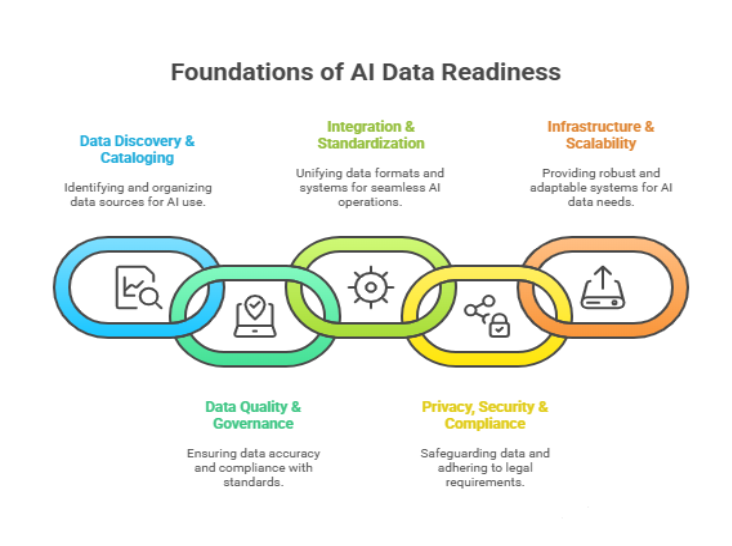
Five Pillars of the AI Data Readiness Framework 2025
AI runs on five essential pillars. Remove one, and the system falls apart. Together, they form a structure where each depends on the rest. Let’s break them down: Five Pillars of the AI Data Readiness Framework 2025
1. Data Discovery and Cataloging
You can’t manage what you can’t see. Most enterprises underestimate the degree of data fragmentation in their landscape, marketing maintains one set of records, operations another, and finance yet another. Unless this sprawl is mapped, AI initiatives stall.
A data audit is the starting point. Ask:
- Where is the data stored?
- Who owns and manages it?
- How fresh and accurate is it?
Modern cataloging platforms, such as Alation, Apache Atlas, and Microsoft Purview, automate discovery and track relationships across both structured and unstructured sources.
They capture lineage (where the data originated, how it has evolved, and who has accessed it).
Treat cataloging as an ongoing practice, not a one-off project. Data evolves with every new customer interaction, merger, or software rollout. Your catalog must evolve with it, or AI models will run on stale, incomplete, or duplicated inputs.
2. Data Quality and Governance
AI systems don’t fail because of algorithms; they fail because of insufficient data. Profiling tools flag incomplete records, inconsistent formats, or duplicate entries. Imagine a model trying to predict churn when 20% of your customer phone numbers are invalid. The insight will be worthless.
Governance acts as the immune system of your data ecosystem. It sets rules that prevent corruption from spreading:
- Who can edit customer records?
- How is product information updated after launch?
- What standards apply during a merger or acquisition?
Strong governance also establishes accountability. When business units disagree on numbers, governance frameworks provide a single point of truth. This not only strengthens AI output but also accelerates decision-making across the company.
3. Integration and Standardization
AI thrives on connected, standardized data, not silos. Yet in most enterprises, marketing runs Salesforce, operations live in SAP, and finance relies on Excel. Each system speaks its own language.
Master Data Management (MDM) tools, such as Informatica, Talend, and Azure MDM, merge these fragments into golden records, a single, accurate version of the truth. AI models can then pull from a consistent, verified source.
But technology is only half the battle. Organizational alignment matters as much. If sales and marketing define a “qualified lead” differently, your AI model will confuse noise for signal. Standardizing definitions across teams prevents derailment before it starts.
4. Privacy, Security, and Compliance
As AI adoption grows, so do risks. Every additional dataset adds exposure points to customer identities, financial histories, and proprietary business models. Mishandling them can mean lawsuits, reputational damage, or regulatory shutdowns.
Privacy-preserving techniques are moving into production:
- Differential privacy protects individual identities while analyzing patterns.
- Federated learning allows models to train on distributed data without moving it.
- Synthetic data generates safe stand-ins for sensitive datasets.
Compliance frameworks (such as GDPR, CCPA, HIPAA, and regional equivalents) should be integrated into your pipelines, not added as an afterthought. Coupled with zero-trust architectures where no system or user is automatically trusted, these practices reduce risk.
The result isn’t just avoiding fines. Strong security and compliance build customer trust. When people believe their data is safe, they share more accurate information, which in turn improves AI outcomes.
5. Infrastructure and Scalability
AI workloads are resource-intensive and unpredictable. A chatbot may require milliseconds of latency tolerance, while a fraud detection engine may experience spikes during peak holiday shopping. Without flexible infrastructure, projects stall under strain.
Cloud platforms, such as AWS, Azure, and Google Cloud, offer elasticity, where resources scale up or down in response to fluctuating workloads. But scalability isn’t only about computing power. It’s about designing for growth.
Today, you might launch an AI project for fraud detection. Tomorrow, that same data pipeline might power supply chain optimization or personalized marketing. If you lock into rigid, single-use infrastructure, you’ll spend more time reengineering than innovating.
Scalable architectures built with containerization (Kubernetes, Docker), data lake houses (Databricks, Snowflake), and pipeline automation (Airflow, Prefect) prepare enterprises for unknown future use cases. Flexibility is the real investment.
Common Pitfalls in AI Data Readiness
AI data readiness isn’t just about building the proper foundation; it’s also about avoiding wrong moves. Enterprises often recognize the risks but still stumble into them. The result? Delayed projects, wasted budgets, and AI models that underperform.
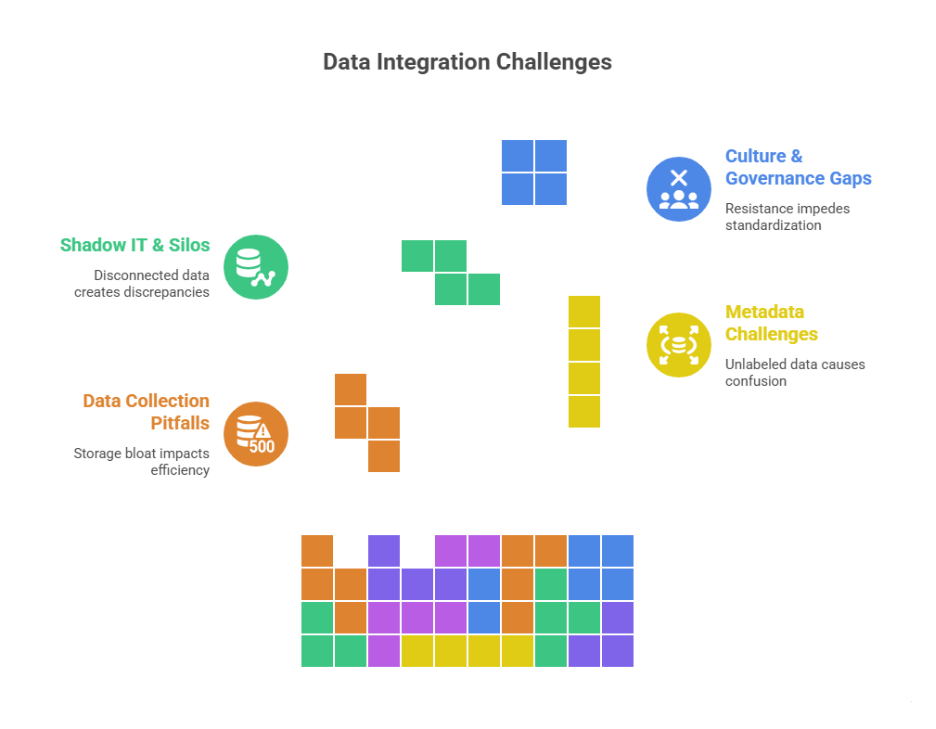
Data Collection Pitfalls in AI Projects
Collecting “everything” sounds smart, but it usually backfires. Companies stockpile logs, transactions, and clickstreams without clear use cases, leading to storage bloat, slower processing, and higher cloud costs. Even worse, the sheer volume makes it harder to filter the signal from noise.
The fix is simple but often ignored: start with a business question. If the goal is churning prediction, don’t waste resources logging data irrelevant to retention. Paradoxically, smaller, purpose-built datasets often deliver better model accuracy than massive, unfocused ones.
Metadata Management Challenges in AI Data Readiness
Raw data looks impressive in size, but without metadata, information about lineage, ownership, and freshness, it’s almost useless. Teams waste time guessing whether a field is reliable or outdated, and AI models ultimately train on flawed inputs.
Enterprises that underestimate the importance of metadata also undermine trust. Data cataloging and lineage tools, such as Microsoft Purview or Apache Atlas, enrich raw tables with context, making them auditable, searchable, and explainable. Without metadata, you’re effectively building AI on sand.
Shadow IT and Data Silos in Enterprise AI
Shadow IT occurs when teams use private spreadsheets, CRMs, or analytics platforms outside of central governance, thereby creating silos. It feels agile in the short term but fragments the data ecosystem. Each department has its own “truth,” and when AI attempts to merge them, models collapse due to inconsistencies.
Strong governance frameworks and master data management prevent this. By standardizing definitions (such as what constitutes a “qualified lead”) and centralizing access, organizations replace silos with golden records that AI can learn from and build upon.
Culture and Governance Gaps in AI Adoption
Buying advanced tools won’t fix cultural resistance. Employees often view governance rules as red tape and bypass them entirely. Even the best platforms fail when people don’t trust the process.
AI data readiness also requires cultural readiness, including data literacy training, leadership support, and clear incentives for adhering to governance standards. When people see how data quality improves their own outcomes, adoption accelerates. Ironically, the “soft” side of readiness is often the hardest to achieve.
Why Avoiding AI Data Readiness Mistakes Matters
AI projects rarely fail due to bad algorithms; they often fail because of poor foundations, including meaningless metadata, bloated storage, hidden silos, or weak governance. Avoiding these pitfalls preserves trust, saves money, and accelerates time-to-value for enterprise AI initiatives.
Enterprises that fix these problems early don’t just protect their investment; they unlock the full potential of AI.
Industry-Specific Applications for Data Readiness
Healthcare: From Compliance to Care Delivery
HIPAA compliance demands anonymization, secure pipelines, and interoperable EMRs. Without standardized formats, AI models can’t unify patient data across systems. Hospitals that prioritize governance and adhere to HL7/FHIR standards unlock AI-driven diagnostics and streamline care.
Finance: Quality in the Milliseconds
In banking and fintech, milliseconds matter. Fraud detection and risk models collapse if transaction data is delayed or corrupted. Real-time pipelines, lineage tracking, and strict compliance frameworks ensure models spot anomalies instantly.
Retail: The SKU Problem That Breaks AI
AI-driven recommendations and demand forecasts fail without clean SKU hierarchies. If “Men’s Shoe – Size 10” isn’t matched with “Sneaker White 10,” the engine misfires. Master data management and taxonomy harmonization turn product chaos into personalized, profitable shopping experiences.
Manufacturing: Sensors Don’t Lie (Until They Do)
IoT-driven predictive maintenance relies on consistent, calibrated sensor data. Irregular or noisy readings can trick AI into issuing false alerts, resulting in unnecessary downtime. Validated pipelines and automated anomaly checks keep machines running smoothly and factories saving millions.
The Shift from Big Data to Smart Data
In the 2010s, business leaders pursued big data, filling servers with vast amounts of data under the assumption that more data equated to greater insight. But as we move deeper into the 2020s, the conversation has shifted toward smart data.
For AI readiness, it’s not about storing every byte; it’s about curating high-quality, signal-rich datasets that truly drive outcomes.
When organizations prioritize data quality over raw quantity, they reduce redundancy, enhance business intelligence, and lay a stronger foundation for scalable AI. The result isn’t just lower storage costs; it’s AI models that learn faster, predict more accurately, and deliver real business value.
Change Management: The Human Factor
Technology isn’t the most challenging part of AI. People are. Many projects stall because users resist workflow changes or leaders underfund data quality work.
Build data literacy across teams. Marketers should understand the importance of lead scoring. Operations managers must see how inventory accuracy drives demand forecasting. Link every data concept to a clear business outcome.
Here’s a full blog-ready section:
KPIs That Prove AI Readiness
You can’t claim AI readiness without measurable proof. The following KPIs show whether your data, infrastructure, and culture are prepared to support scalable AI.
1. Data Quality Score
AI fails on bad data. Tracking the percentage of clean, validated, and deduplicated records ensures models aren’t trained in noise. A high score signals trustworthiness in your dataset.
2. Data Accessibility Index
If business-critical data is locked in silos, AI projects stall. This KPI measures the share of data sources accessible via APIs or integrated pipelines. The higher the index, the faster teams can operate AI.
3. Metadata Coverage
AI models need context. This KPI reflects the percentage of your data that is properly documented with lineage, ownership, and governance details. Strong metadata coverage prevents compliance risks and accelerates onboarding.
4. Infrastructure Uptime
Downtime kills scalability. Tracking the availability of data pipelines, storage, and processing systems gives an objective view of reliability. Enterprises aiming for AI at scale should strive for a benchmark uptime of 99.9% or higher.
5. Model Deployment Speed
A model sitting in a lab has zero business value. This KPI measures the average time from prototype to production. Faster deployment cycles enable teams to iterate and capture ROI more quickly.
6. AI Adoption Rate
It’s not just about building models; it’s about using them. This KPI measures the percentage of business units that embed AI-driven insights into their decision-making. A rising adoption rate signals cultural readiness, not just technically.
7. Compliance Audit Pass Rate
Regulation can make or break AI projects. This KPI reflects the number of datasets and pipelines that pass external or internal compliance audits. High pass rates reduce the risk of costly setbacks later.
When these KPIs are tracked in parallel, organizations move beyond proof-of-concept experiments into enterprise-grade AI maturity, the point at which AI readiness translates directly into a sustainable business advantage.
AI Data Readiness in 2025
AI is no longer in trial mode; it’s running at full speed. Models read contracts in seconds, edge systems make supply chain decisions on the fly, and computer vision is transforming how factories operate. The tools are ready. The real test is whether your data is.
In 2025, data readiness is the dividing line. Companies that focus on clean, well-managed, and scalable data are moving faster. They gain clearer insights, build models that people can trust, and launch AI systems at scale, while others are still planning.
The rest? They stall. Projects die in testing. Regulators raise red flags. Customers lose trust when models give shaky results. A small failure today becomes a bigger loss tomorrow. This is not just trial and error; it’s win or lose.
The choice is clear: get your data AI-ready and grow or fall behind as competitors take the lead.
Next Steps for Scalable AI Success
- Start Small: Pick one high-value use case. Learn and expand.
- Invest in People: Build internal skills, supported by consultants where needed.
- Build Incrementally: Good-enough data beats waiting for perfect data.
- Measure Relentlessly: Track quality, outcomes, and adoption.
- Stay Curious: AI evolves quickly, so must your data strategy.
The AI Data Readiness Framework 2025 is more than technical hygiene. It’s your ticket to long-term competitiveness.